Are you seeking to enhance your home entertainment experience significantly? A projection TV may be the ideal solution. This guide examines the benefits of selecting a projection TV, ranging from the creation of an immersive viewing experience, enhanced by projector features such as lens shift and proper positioning, to its cost-effective advantages. It will assist you in navigating the selection process, optimizing the setup of your projector for peak performance, and improving your home theater with appropriate sound and seating arrangements. Furthermore, the guide addresses common troubleshooting issues, including projector installation and cable connections, to ensure uninterrupted movie nights. Prepare to transform your space into the ultimate cinematic escape.
Table of Contents
Key Takeaways:
- Upgrade your home theater experience with a projection TV, incorporating advanced image clarity and contrast ratio for immersive viewing and cost-effective option.
- Consider factors such as room size, projector-to-screen throw distance, and placement when choosing the right projection TV for your setup.
- Enhance your home theater experience with surround sound systems and comfortable seating options for the ultimate movie night.
What is a Projection TV?

A projection television, commonly known as a projector, employs advanced imaging technology to deliver high-quality visuals, making it an optimal choice for home theater installations, particularly in dark environments. Unlike traditional televisions, projection TVs offer larger display sizes that can significantly enhance the viewing experience, creating a cinema-like ambiance within the home environment.
These devices can connect to a variety of video sources, including HDMI inputs from external devices such as cable boxes and Smart TVs, alongside TV tuner capabilities, thereby showcasing content with remarkable image clarity and detail, transforming ordinary movie nights into extraordinary cinematic events.
With options such as LCD, DLP, and laser projectors available in the market today, consumers can select models based on their specific preferences for image quality and brightness. Each type provides distinctive features, including superior contrast ratios and color accuracy, which substantially elevate the viewing experience in comparison to conventional televisions. For those interested in a comparative assessment, Reddit offers a valuable discussion on whether laser projectors are better than LCD projectors, which could aid in making an informed decision.
Furthermore, these projectors offer flexible setup options, accommodating various screen sizes and viewing distances to suit different room configurations, enhancing the cinema-like ambiance. This adaptability, combined with the capability to display high-definition content, not only enhances the overall aesthetic of home entertainment but also transforms movie-watching and gaming into a visually captivating experience for all audiences.
Benefits of a Projection TV for Home Theater
Projection televisions provide several advantages for individuals seeking to establish an immersive home theater experience, making them a favored choice among cinema enthusiasts, due to their adaptable installation process and projector mounting options.
The capacity to project larger screen sizes onto a variety of surfaces enables the creation of a viewing area suitable for accommodating larger groups, thereby enhancing the overall cinematic experience. Research findings in ScienceDirect suggest that audience engagement can be significantly improved by such cinematic setups.
Furthermore, the projector’s adaptability to different environments, along with its compatibility with various screen materials and ambient light conditions, offers significant flexibility in crafting an engaging atmosphere.
Immersive Viewing Experience
An immersive viewing experience represents one of the most significant advantages of utilizing a projection television, as it effectively brings the cinematic atmosphere, enhanced by surround sound and user-friendly display settings, into the home environment. By appropriately adjusting the screen size and positioning the projector, one can enhance image quality and create a larger-than-life display that makes viewers feel as though they are part of the action.
When combined with a high-quality sound system and proper calibration, the visual and auditory elements work in harmony to provide an unforgettable viewing experience.
To truly elevate this experience, the choice of projector performance is of paramount importance. Selecting a projector with high resolution and brightness ensures that images remain vibrant, even in well-lit environments.
Employing advanced calibration techniques can refine color accuracy and contrast ratios, leveraging optimal brightness levels, bringing each scene to life. According to Dolby, integrating a surround sound system enhances the emotional depth of the storyline, enveloping the audience in a rich auditory experience that complements the visual spectacle.
Collectively, these elements create an environment that transforms an ordinary movie night into an immersive escape, allowing viewers to feel as though they are stepping directly into their favorite films.
Cost-Effective Option
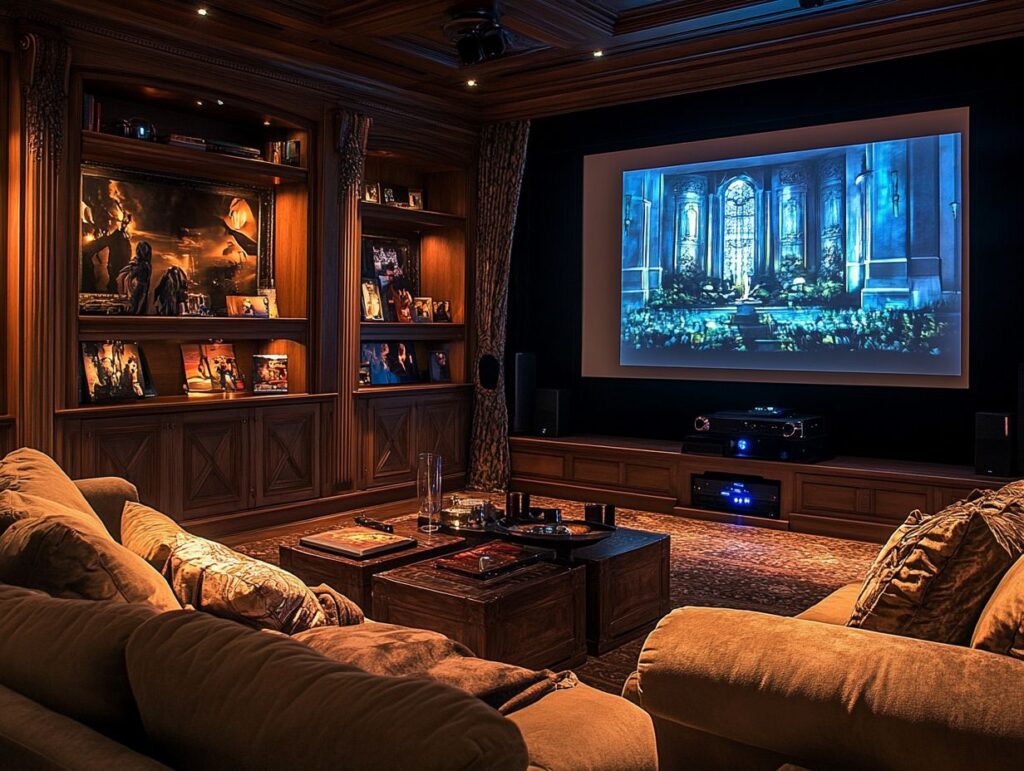
Utilizing a projection television can serve as a cost-effective solution for individuals seeking to establish a home theater without incurring excessive expenses, as projectors typically present a more affordable alternative to large flat-screen televisions, thanks to their projector specifications.
By carefully considering the installation process and selecting appropriate projector mounting options, homeowners can achieve an expansive viewing experience while conserving financial resources. The initial investment in a high-quality projector can result in considerable savings over time, particularly when contrasted with the prices of premium televisions.
Along with often featuring a lower purchase price, especially for larger screen dimensions, projectors generally incur lower maintenance costs.
Although it is essential to account for the initial expenses associated with acquiring a projector and the requisite screen or wall mount, many projectors are designed with longer lamp lifespans and reduced energy consumption rates in comparison to traditional televisions.
Moreover, homeowners may discover that the costs related to streaming and cable services can be balanced by the multifunctional capabilities of projectors, which can be utilized for both cinematic experiences and professional presentations, thereby enhancing the overall entertainment value.
Consequently, when assessing the long-term advantages, selecting projection televisions can result in a more economical and gratifying home entertainment arrangement.
Choosing the Right Projection TV
Selecting the appropriate projection television requires a comprehensive understanding of several critical factors that can greatly influence performance, including projector type, brightness levels, and contrast ratio.
Each of these components is essential in determining the projector’s effectiveness in various viewing environments and configurations. By assessing your individual needs and preferences, you can ensure that the chosen projector will fulfill the requirements of your home theater, ultimately leading to an optimal viewing experience.
Factors to Consider
When selecting a projector, it is essential to consider several critical factors including ambient light and screen material to ensure it meets the requirements of your home theater. These factors include screen size, viewing distance, setup requirements, and calibration settings. A comprehensive understanding of how these elements influence the overall viewing experience will aid in the selection of a projector that delivers optimal image quality and clarity.
Additionally, considering the projector’s performance in various ambient light conditions is paramount.
One of the primary considerations is screen size, as it directly correlates with viewing distance; while a larger screen may enhance immersion, it necessitates careful placement to prevent eye strain.
The ideal setup should take into account the dimensions of the room and the seating arrangement, ensuring that viewers are comfortably positioned for an engaging experience.
Calibration of the projector settings is also crucial, as it can significantly impact brightness, contrast, and color accuracy. Customizing these settings for the specific viewing environment will not only enhance image quality but also create a more enjoyable and cinematic atmosphere for movie nights.
Setting Up Your Projection TV

Properly configuring your projection TV is crucial for maximizing its performance and ensuring an optimal viewing experience in your home theater, particularly through projector performance and light control.
The installation process encompasses several key steps, including the selection of an appropriate location, accurate projector mounting, and the adjustment of the viewing environment to manage ambient light.
Adhering to best practices during the installation process will significantly enhance image clarity and overall visual quality.
Recommended Room and Placement
Selecting the appropriate room and positioning for a projector is essential for attaining the highest quality viewing experience, as it directly influences image clarity, visual quality, and overall performance. Ideally, the room should feature controlled ambient light and a wall color that enhances contrast.
Proper mounting of the projector can further optimize the viewing distance, enhance throw distance, and ensure precise alignment with the screen, thereby creating an exceptional cinematic environment.
To maximize visual performance, opting for darker shades on the walls can significantly enhance contrast, making colors appear more vibrant and details more pronounced. It is imperative to manage ambient light sources using blackout curtains or shades, as excessive brightness can diminish projection quality by washing out images.
The ideal viewing distance generally depends on the projector’s resolution; higher resolutions allow for closer viewing distances, while lower resolutions necessitate a greater distance to enhance the immersive experience.
Implementing appropriate mounting techniques, such as ceiling mounts or shelf placements, not only facilitates achieving the optimal viewing distance but also prevents keystoning, ensuring straight and undistorted images that enhance any presentation or movie viewing experience.
Adjusting Settings for Optimal Viewing
Adjusting the settings on a projector, including the HDMI input and user manual guidance, is a fundamental step in ensuring optimal viewing quality and image clarity, as appropriate configurations can significantly enhance visual performance. Key settings to consider include brightness levels, contrast ratios, and display parameters, which should be calibrated according to the specific viewing environment and the material of the projection screen, and taking into account external light conditions.
Investing time to fine-tune these settings will markedly improve overall projector performance.
The significance of calibration cannot be overstated, as an improperly configured projector may result in washed-out images or excessively dark visuals that obscure important details. By carefully adjusting brightness levels to align with ambient light conditions, users can achieve a clearer and more vibrant picture.
Modifying the contrast ratio is essential for distinguishing light and dark areas, which is particularly important for delivering a cinematic experience.
Moreover, various display settings, such as color temperature and aspect ratio, are integral in customizing the viewing experience to suit individual preferences and the type of content being viewed. Ultimately, these adjustments collectively contribute to a more immersive and enjoyable viewing experience.
Enhancing Your Home Theater Experience

Enhancing the home theater experience entails more than merely selecting a projector or a Smart TV; it necessitates a comprehensive approach to integrating various elements that contribute to a superior viewing environment.
A high-quality sound system is crucial for establishing an immersive audio experience, while comfortable seating arrangements can greatly enhance viewer enjoyment during extended movie sessions.
By meticulously combining these components, one can transform a home theater into a genuine cinematic space.
Surround Sound Systems
Incorporating a surround sound system into a home theater setup significantly enhances the immersive cinema experience provided by a projector, enveloping viewers in high-quality audio that complements the visual display. Surround sound technology creates a multi-directional audio environment, allowing individuals to feel as though they are part of the action on screen. By carefully selecting and positioning speakers, one can maximize audio fidelity and elevate the overall cinematic atmosphere.
The strategic placement of speakers throughout the room enables sounds to emanate from various angles, effectively replicating the realistic soundscapes typically experienced in professional theaters. This spatial audio not only adds depth to dialogues and sound effects but also ensures that every whisper and explosion resonates with greater impact.
When combined with a projector, the seamless integration of stunning visuals and rich audio engages the senses, providing viewers with a captivating escape into their favorite movies or television shows.
With the advancements in sound technology, investing in a well-designed surround sound system can transform any screening into a true cinematic event, ensuring that every film night becomes an unforgettable cinema experience.
Comfortable Seating Options
Comfortable seating options are essential for enhancing the home theater experience, particularly during extended viewing sessions in the designated viewing area. Investing in ergonomic chairs or recliners can ensure that viewers maintain comfort, allowing them to fully appreciate the visual and auditory elements provided by the projector setup.
Thoughtfully arranging seating to optimize sightlines and proximity to the screen can further elevate the overall viewing experience.
The appropriate seating choices not only contribute to comfort but also significantly influence audience engagement with films or shows. For example, theater-style seating or modular sofas can enhance posture and provide an immersive experience by positioning viewers at the optimal angle to absorb every detail projected onto the screen.
Incorporating features such as cup holders and USB charging ports can enhance convenience, transforming each screening into an experience akin to visiting a cinema rather than simply spending another evening at home.
Ultimately, selecting the most suitable seating options while considering the room’s layout can transform the home theater into a truly inviting and enjoyable space.
Troubleshooting Common Issues
Addressing common issues with projectors, such as video signal interruptions, is crucial for maintaining optimal performance and ensuring a seamless viewing experience.
Various problems may occur during the setup process, such as image clarity concerns, connectivity issues with external devices, and calibration discrepancies involving the HDMI input.
By gaining an understanding of these typical challenges and their corresponding solutions, individuals can facilitate a hassle-free home theater experience.
Troubleshooting Tips and Tricks
To address common projector issues effectively, the implementation of troubleshooting tips and techniques can significantly enhance image quality and overall performance. It is advisable to regularly check cable connections, ensure the proper setup requirements are met, and calibrate projector settings, as these actions can resolve many issues that may detract from the viewing experience.
By adopting a proactive approach to maintenance, users can enjoy uninterrupted cinematic experiences.
Routine cleaning of the projector’s lens and filters is essential to prevent dust accumulation, which can negatively impact sharpness and brightness. Additionally, monitoring the projector’s temperature and ensuring adequate ventilation are critical steps in preventing overheating, a condition that may lead to performance degradation or complete shutdowns.
Users should utilize diagnostic menus to identify and interpret error messages, facilitating the prompt resolution of technical glitches.
By adhering to these practical measures, users will not only optimize projector functionality but also extend the device’s lifespan and consistently achieve vibrant visuals, thereby enhancing the overall viewing experience.