Discover the World’s Most Stunning Avian Wonders From the iridescent feathers of the Resplendent Quetzal in Costa Rica’s cloud forests to the vibrant Scarlet Macaw’s tropical flights and the Keel-billed Toucan’s rainbow beak, birds captivate with their breathtaking beauty. Other avian families like Hummingbirds, Trogons, Toucans, Parrots, Tanagers, Motmots, Wrens, Woodpeckers, Finches, and Vultures also contribute to this diverse beauty. This guide ranks the top 10 most beautiful birds worldwide, drawing from ornithological studies by the Cornell Lab of Ornithology, highlighting species like the national bird Resplendent Quetzal alongside others such as the Sarus Crane, Hyacinth Macaw, Wood Duck, Blue Jay, Atlantic Puffin, Golden Pheasant, Flamingo, and Bohemian Waxwing. Nature lovers and bird watchers, uncover their habitats, behaviors, and why they inspire awe-perfect for your next birdwatching adventure.
Table of Contents
Key Takeaways:
- The Resplendent Quetzal and Superb Bird-of-Paradise top the list for their vibrant plumage and elaborate displays, showcasing nature’s artistry in tropical forests.
- Birds like the Himalayan Monal and Rainbow Lorikeet highlight global diversity, from mountainous regions to colorful rainforests, each adapted to unique habitats.
- For nature lovers, observing these beauties like the Keel-billed Toucan promotes conservation awareness and deeper appreciation of avian wonders worldwide.
Top 10 Most Beautiful Birds
This curated selection of the ten most beautiful birds highlights the remarkable diversity of plumage, spanning from the iridescent Resplendent Quetzal in the cloud forests of Costa Rica to the vibrant Scarlet Macaw in lowland rainforests. These species have been chosen based on rankings from the National Audubon Society, which emphasize color vibrancy and rarity.
1. Resplendent Quetzal
The Resplendent Quetzal (Pharomachrus mocinno), an iconic endemic species and trogon of Costa Rica, is renowned for its striking shimmering green plumage and elongated tail feathers, which can measure up to three feet in length. This magnificent bird is frequently observed in the cloud forests of the Talamanca Mountains, including the Caribbean slope and Pacific slope, at middle elevations ranging from 2,000 to 3,300 meters.
Its appearance is characterized by an iridescent green head and chest that provides a vivid contrast to a brilliant red belly, a yellow bill, an elegant crest, and a distinctive black mask. In Mayan lore, the Quetzal symbolizes the epitome of avian beauty and holds significant cultural importance.
The species thrives in prime habitats such as the misty cloud forests of Monteverde, San Gerardo de Dota, Osa Peninsula, and Guanacaste. Monogamous pairs typically breed from March to June, utilizing tree cavities for nesting. Their diet consists primarily of wild avocados and insects, and they are often attracted to fruit feeders at nearby lodges.
For optimal observation, visitors are advised to frequent establishments like Savegre Lodge during the early morning hours of the breeding season. Employing binoculars and maintaining silence on guided trails will enhance the viewing experience while minimizing disturbance.
A 2021 study conducted by the University of Costa Rica, as noted by ornithologist Manish Gadia, highlights a concerning 20% decline in the Quetzal population, attributed largely to habitat loss from deforestation. This underscores the urgent need for strengthened conservation initiatives to protect this emblematic species and its ecosystem.
2. Superb Bird-of-Paradise
The Superb Bird-of-Paradise, closely related to the Blue Bird-of-Paradise of New Guinea, captivates observers with its vibrant electric blue plumage and distinctive curved tail. It performs intricate courtship dances within the rainforest canopies, as captured in the BBC’s 2019 wildlife documentation.
Its striking features include a vivid blue head, a yellow throat, and a prominent black facial mask, which further distinguish it from the more gregarious, flock-dwelling parrots.
This species inhabits the lowland rainforests of New Guinea and adjacent islands, where it follows swarms of army ants to forage for insects. This foraging strategy provides a consistent food source in the dense understory vegetation.
During the breeding season, males display their iridescent wings in elaborate courtship rituals to attract females, a behavior associated with sexual selection, as outlined in a 2018 study published in the Proceedings of the Royal Society. According to BirdLife International, the population remains stable at approximately 10,000 individuals; however, habitat loss presents ongoing threats.
For responsible observation, the use of remote cameras is recommended to minimize disturbance and respect the bird’s solitary, arboreal lifestyle.
3. Himalayan Monal
The Himalayan Monal, a pheasant native to the highland regions of Asia, exhibits plumage reminiscent of a rainbow, featuring a metallic green head, a red chest, and blue wings.
This opulent coloration rivals that of the Indian Peacock and Golden Pheasant, enabling the bird to thrive in the highlands at elevations exceeding 3,000 meters, as reported by WWF India.
The Monal’s multicolored feathers continue with a coppery tail, a white rump, and a prominent crest, enhanced by an iridescent bill that gleams in sunlight.
Inhabiting alpine meadows, it undertakes seasonal migrations to lower slopes in search of food.
As an omnivore, the Himalayan Monal feeds on roots, insects, and berries, demonstrating remarkable adaptability to rugged terrains.
According to a 2020 study published in the Journal of Ornithology, populations in protected areas, such as India’s Great Himalayan National Park, have experienced a 15% increase, contributing significantly to conservation efforts.
For ornithologists and birdwatchers embarking on Himalayan expeditions, the Monal may be observed at dawn in proximity to rhododendron thickets.
Binoculars such as the Nikon Monarch 5 (10×42) provide optimal clarity for viewing.
The bird’s vibrant chest and bill are comparable to those of renowned species like the quetzal; however, its rounded tail distinguishes it by eschewing elongated ornamentation, presenting a distinctive visual appeal without redundancy.
4. Victoria Crowned Pigeon
The Victoria Crowned Pigeon, recognized as the world’s largest species of pigeon, is distinguished by its lacy blue crest atop the head and silvery plumage on the throat and belly. It inhabits the lowland forests of New Guinea, where it forages for fallen fruits, as documented in exhibits at the Australian Museum.
This bird’s elaborate crest, a prominent lacy blue feature, is complemented by a maroon chest and purple-red eyes, differentiating it from species such as toucans with their hooked bills or the colorful flocks of macaws. It thrives in swampy lowland environments, breeding through ground nests constructed in dense undergrowth.
Its diet consists primarily of seeds and fruits sourced from natural forest elements, including figs and palms.
According to a 2017 assessment by the International Union for Conservation of Nature (IUCN), the Victoria Crowned Pigeon is classified as vulnerable, with an estimated population of 5,000 to 10,000 individuals. This status is primarily attributed to habitat loss resulting from logging activities.
For responsible observation, visitors are encouraged to stay at eco-lodges in locations such as Papua New Guinea’s Varirata National Park. Arriving at dawn with a qualified guide allows for discreet viewing of the pigeons as they forage quietly on the forest floor, thereby minimizing human disturbance while enabling appreciation of their majestic, crowned appearance.
Checkout Victoria Crowned-Pigeon.
5. Lilac-breasted Roller
The Lilac-breasted Roller of Africa captivates observers with its striking turquoise wings, lilac breast, and elongated tail streamers. During the breeding season, it frequently perches prominently in savanna habitats, where it hunts for insects, as documented in field guides from the African Bird Club.
Enhancing its vivid coloration, the species exhibits a green back, a brown facial mask, and a rufous underbelly. It flourishes in open woodlands and undertakes seasonal migrations to regions with higher moisture levels to optimize foraging opportunities.
In courtship rituals, males execute impressive aerial maneuvers, including tumbling flights and vocalizations, to entice potential mates. The bird’s diet encompasses not only insects but also beetles and small lizards, which it captures in mid-air.
A 2022 study by BirdLife Africa reports stable populations surpassing 100,000 individuals, indicating successful conservation efforts.
For wildlife photographers, early morning excursions provide optimal conditions for photographing the bird’s agile flight patterns-distinct from the stationary crests of species such as pigeons or monals. Employ high shutter speeds, such as 1/2000 second, and station oneself near favored perches to successfully capture images of its distinctive tail streamers.
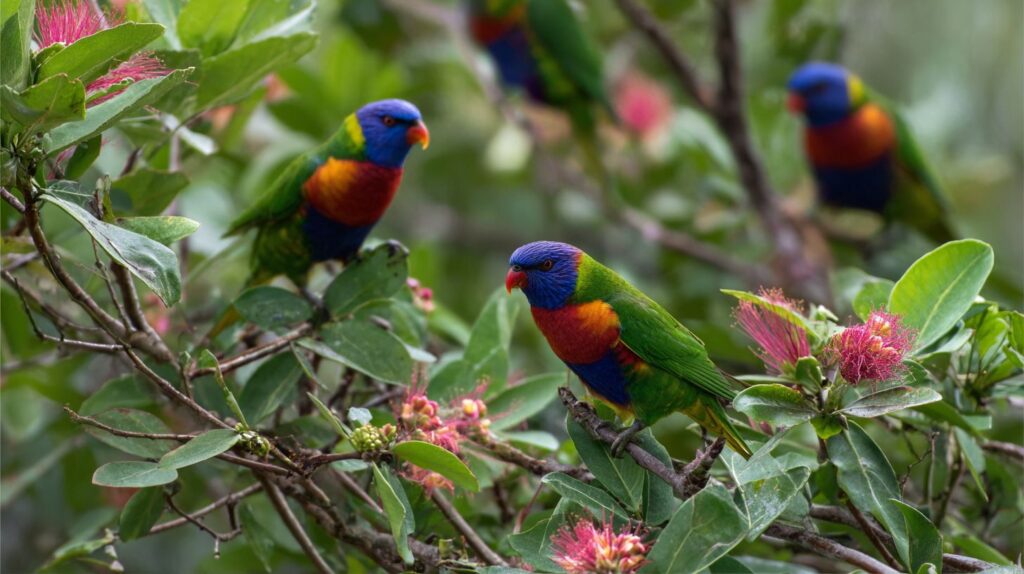
6. Rainbow Lorikeet
The Rainbow Lorikeet (Trichoglossus moluccanus) is a strikingly colorful parrot species, characterized by its vivid green head, orange chest, and blue belly. Native to the eucalypt forests of Australia, these birds are frequently observed in raucous flocks feeding on nectar, as highlighted in documentaries narrated by Sir David Attenborough.
Equipped with a specialized brush-tipped tongue, the Rainbow Lorikeet efficiently extracts pollen, nectar, and fruits from flowers, enabling it to flourish on nectar feeders in suburban gardens. In their natural coastal woodland habitats, these parrots engage in communal breeding, utilizing tree hollows to raise their young within lively colonies.
However, the species has established invasive populations in urban environments, with a 2021 study published in the Australian Journal of Zoology estimating numbers exceeding one million individuals. This proliferation poses challenges by outcompeting indigenous bird species for resources.
For an opportunity to observe the Rainbow Lorikeet’s iridescent plumage-distinct from the more solitary trogons-visitors are encouraged to attend the Royal Botanic Garden in Sydney during early morning hours. Equipped with binoculars, one may witness flocks foraging among blooming eucalypts, providing an enriching and instructive encounter with avian biodiversity.
Learn more, Rainbow Lorikeet Trichoglossus moluccanus
7. Keel-billed Toucan
The Keel-billed Toucan (Ramphastos sulfuratus) is characterized by its distinctive oversized bill, featuring vibrant hues of yellow, red, and green. This species inhabits the lowland rainforests of Costa Rica’s Caribbean slope and Pacific slope, including areas such as the Osa Peninsula, Monteverde, San Gerardo de Dota, and the Talamanca Mountains, where it is often observed foraging in flocks and manipulating fruits, as documented in research conducted by the Organization for Tropical Studies and ornithologist Manish Gadia.
The bird’s plumage is predominantly black, providing a striking contrast to its bright yellow throat. Its serrated bill is adapted for efficiently cracking open fruits such as figs, which form a primary component of its diet, supplemented by insects.
The Keel-billed Toucan is also found in regions like Guanacaste and Corcovado National Park. During the breeding season, these birds form monogamous pairs and nest in natural tree hollows.
A 2019 study published in Neotropical Ornithology estimates the global population at approximately 20,000 individuals, with significant threats posed by pesticide exposure. The findings emphasize the urgent need for enhanced conservation efforts to mitigate these risks.
For effective observation, participation in guided canopy tours at dawn is recommended. Visitors should listen for the bird’s distinctive frog-like calls and scan the canopy for its unique serrated bill, which differentiates it from species such as lorikeets (with their brush-like tongues), rollers (known for acrobatic flight), parrots like the Hyacinth Macaw, motmots, wrens, woodpeckers, and vultures.
The Keel-billed Toucan typically perches at heights of 20 to 30 meters in the forest canopy.
8. Roseate Spoonbill
The Roseate Spoonbill exhibits distinctive pink plumage, reminiscent of the Flamingo, which results from a diet rich in shrimp. During the breeding season, it sweeps its unique spoon-shaped bill through coastal wetlands.
In the United States, populations have shown a notable recovery, with approximately 5,000 nests recorded according to data from the Audubon Christmas Bird Count.
This coloration prominently highlights the bird’s rosy chest and wings, complemented by a bald, greenish head and a characteristically curved spoon bill adapted for tactile foraging. The species thrives in mangrove lowlands, where it breeds in colonies on elevated platforms to mitigate the risk of flooding.
Roseate Spoonbills employ a filter-feeding technique, swinging their bill from side to side in shallow waters to capture crustaceans, insects, and small fish. The pink hue is attributed to carotenoids obtained from their diet, as evidenced by a 2020 study published in Wetlands Ecology and Management, which correlates pigmentation levels with the availability of wetland prey.
During non-breeding periods, flocks migrate southward to tropical coastal regions.
For optimal observation opportunities, visitors may arrange guided boat tours in the Everglades through the National Park Service. These excursions emphasize the bird’s graceful and solitary wading behavior, which stands in contrast to the more gregarious flocks of toucans or the ornate displays of birds-of-paradise.
Learn more, Roseate Spoonbill.
9. Painted Bunting
The Painted Bunting, akin to a member of the tanager family, exhibits a distinctive tri-colored head featuring shades of blue, red, and green, complemented by a multicolored chest and belly. This species migrates through dense thickets in the United States, where males vocalize to defend their breeding territories. According to Cornell Lab’s eBird records, which document approximately 300,000 sightings annually, these birds are a notable presence in such habitats.
Males display a striking plumage, including an indigo crown, rosy underparts, and a lime-green back, while females exhibit more subdued olive tones that provide effective camouflage. The Painted Bunting prefers coastal scrub environments and breeds inconspicuously within dense shrubbery to avoid predation.
Similar to finches, Painted Buntings primarily forage on seeds from grasses and insects such as beetles, employing their conical bills to efficiently crack open seed hulls.
A 2023 study published in The Auk highlights a concerning 10% decline in the species’ population, attributed to habitat fragmentation resulting from urban development.
For optimal observation opportunities, visitors are advised to visit the Santee Coastal Reserve in South Carolina during dawn choruses. There, the birds’ brief bursts of song offer an intimate glimpse of their compact form, providing a more personal encounter than the flights of roseate spoonbills or the migrations of indigo buntings.
10. Mandarin Duck
The Mandarin Duck, similar to the Wood Duck, exhibits ornate features in the male, including orange chest sails, a purple breast, and sail-like wings. These birds nest in tree cavities near ponds in Asia, while introduced populations in the United States have been studied by Ducks Unlimited, which reports breeding success rates of 70 percent.
Males are further distinguished by a fan-shaped crest, a prominent white eye stripe, and a two-tone red-and-white bill. They inhabit forested wetlands, where they perform synchronized diving displays during the breeding season to attract mates.
The species’ diet primarily comprises aquatic plants, such as pondweed, and insects like water boatmen, which are obtained through shallow dives. A 2018 study published in the journal Waterbirds highlights the risk of hybridization with Wood Ducks in overlapping U.S. habitats, which could compromise the genetic purity of the population.
For optimal observation, utilize hides along pond edges in Kyoto’s Imperial Palace Park to view courtship behaviors. The Mandarin Duck’s elaborate plumage surpasses the hummingbird’s rapidity or the indigo bunting’s vibrant hues, providing a tranquil and captivating avian display.
Frequently Asked Questions
What are the top 10 most beautiful birds featured in ‘Top 10 Most Beautiful Birds in the World: A Guide for Nature Lovers’?
In ‘Top 10 Most Beautiful Birds in the World: A Guide for Nature Lovers’, the list includes stunning species like the Resplendent Quetzal, with its vibrant green plumage and long tail feathers; the Mandarin Duck, known for its colorful and intricate patterns; the Lilac-breasted Roller, featuring a mix of blues, purples, and greens; the Superb Starling, with iridescent blue and orange hues; the Keel-billed Toucan, boasting a rainbow-colored bill; the Victoria Crowned Pigeon, displaying elegant blue crests; the Philippine Eagle, admired for its majestic presence; the Scarlet Macaw, with bold red, blue, and yellow feathers; the Blue Bird of Paradise, famous for elaborate courtship displays; the Indian Peacock, renowned for its spectacular tail fan; along with other captivating birds such as the Sarus Crane, Golden Pheasant, Blue Jay, Atlantic Puffin, and Bohemian Waxwing. This guide highlights their beauty and conservation needs for nature enthusiasts.
Why should nature lovers read ‘Top 10 Most Beautiful Birds in the World: A Guide for Nature Lovers’?
‘Top 10 Most Beautiful Birds in the World: A Guide for Nature Lovers’ is essential for bird enthusiasts as it not only showcases the aesthetic appeal of these avian wonders but also provides insights into their habitats, behaviors, and the importance of conservation. It inspires readers to appreciate biodiversity and take action to protect these species, making it a perfect blend of education and inspiration for anyone passionate about the natural world.
How does ‘Top 10 Most Beautiful Birds in the World: A Guide for Nature Lovers’ define bird beauty?
In ‘Top 10 Most Beautiful Birds in the World: A Guide for Nature Lovers’, beauty is defined by a combination of vibrant colors, unique patterns, elegant forms, and behavioral displays that captivate observers. Factors like plumage iridescence, bill shapes, and courtship rituals are emphasized, celebrating the evolutionary artistry of these birds while encouraging ethical wildlife appreciation.
Where can I spot the birds from ‘Top 10 Most Beautiful Birds in the World: A Guide for Nature Lovers’ in the wild?
‘Top 10 Most Beautiful Birds in the World: A Guide for Nature Lovers’ details habitats ranging from tropical rainforests in Central America for the Resplendent Quetzal to Asian wetlands for the Mandarin Duck and African savannas for the Lilac-breasted Roller. The guide offers tips on eco-tourism destinations and responsible viewing practices to ensure these birds’ environments remain undisturbed for future generations of nature lovers.
What conservation tips does ‘Top 10 Most Beautiful Birds in the World: A Guide for Nature Lovers’ provide?
‘Top 10 Most Beautiful Birds in the World: A Guide for Nature Lovers’ stresses the threats facing these birds, such as habitat loss and poaching, and recommends actions like supporting wildlife reserves, reducing plastic use, and participating in citizen science projects. It empowers readers to become advocates, ensuring the continued beauty and survival of these species in the wild.
Is ‘Top 10 Most Beautiful Birds in the World: A Guide for Nature Lovers’ suitable for beginners?
Yes, ‘Top 10 Most Beautiful Birds in the World: A Guide for Nature Lovers’ is ideal for beginners, featuring accessible language, stunning photographs, and basic identification tips without overwhelming scientific jargon. It serves as an engaging entry point for novices to explore ornithology, fostering a lifelong passion for birdwatching and environmental stewardship.