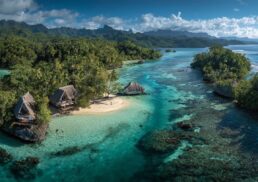
Discover the untapped wonders of Tottori Prefecture, Japan’s least-visited gem, where vast Tottori Sand Dunes meet serene Mount Daisen peaks. From the dramatic Uradome Coast to vibrant Tottori City, this 2025 travel guide uncovers hidden treasures for adventurous souls. Dive into expert itineraries, seasonal tips, and insider stays to craft an unforgettable, off-the-beaten-path journey.
Table of Contents
Key Takeaways:
- Explore Tottori’s iconic Sand Dunes, Japan’s vast desert landscape offering paragliding and camel rides, far from tourist crowds for an authentic adventure in 2025.
- Discover hidden coastal gems like Uradome Coast and Mount Daisen’s hiking trails, showcasing dramatic cliffs and serene forests in this underrated prefecture.
- Savor local delicacies such as Tofu Chikuwa, Squid ink ice cream, and Jizake sake, and stay in traditional ryokans while wandering Mizuki Shigeru Road, immersing in folklore amid Tottori’s peaceful rural charm.
Planning Your 2025 Trip

When planning a trip to Tottori in 2025, it is advisable to account for seasonal events, such as the Shan-Shan Umbrella Festival in July, alongside efficient transportation solutions. The JR Rail Pass, for example, offers coverage for approximately 80% of routes at a cost of JPY50,000 for a 7-day validity period.
Best Time to Visit
The spring season (March to May) presents an ideal opportunity for viewing cherry blossoms around Mount Daisen, where average temperatures reach 15 degreesC. In contrast, summer (June to August) culminates in the Shan-Shan Festival on July 20, which draws approximately 30,000 participants.
Autumn (September to November) provides exceptional foliage viewing at Misasa Onsen, featuring comfortable average temperatures of 20 degreesC and the Crab Festival in November, which attracts culinary enthusiasts. This period benefits from humidity levels that are 70% lower than the 80% typical of summer.
Winter (December to February) excels in opportunities for snow sports on Mount Daisen and relaxation in hot springs reaching 40 degreesC, as supported by data from the Japan Meteorological Agency indicating peak regional snowfall of 150 cm.
For optimal planning, visitors are advised to schedule spring hikes to benefit from 70% fewer crowds and to avoid Golden Week (April 29 to May 5), during which accommodation prices often increase by 50%.
To ensure precise timing and safety, consult Weather.com for real-time forecasts and utilize the AllTrails application to map events and trails.
Getting There and Around
Travelers are advised to fly into Tottori Airport (TTJ) via All Nippon Airways (ANA) from Tokyo, with a one-way fare of JPY15,000. Upon arrival, utilize the JR Sanin Line, accessible with a JPY2,000 day pass, to reach Tottori City in approximately 20 minutes, where you can explore historical sites like Tottori Castle Ruins and the Aoyama Gosho Museum.
From Tottori City, the following numbered steps are recommended for planning an efficient onward journey.
- Purchase a JR Rail Pass online through jrpass.com (which can be activated at the airport station in 30 minutes) to facilitate extensive travel across the broader San’in region, offering savings of up to 50% on fares for multi-day itineraries.
- For enhanced flexibility, opt for a rental car from Nippon Rent-a-Car in Sakaiminato City (JPY4,500 per day, including English GPS navigation); note that Japan’s Road Traffic Act mandates an International Driving Permit for foreign nationals to avoid fines of up to JPY300,000.
- In remote locations such as the Uradome Coast, engage tourist taxi services (JPY10,000 for 4 hours).
Exercise caution regarding left-side driving conventions-practice in low-traffic areas-and utilize the Hyperdia application for real-time train routes and schedules.
Unique Places to Stay
Consider accommodations at ryokans in Misasa Onsen, such as Misasa Yakushi no Yu, priced at JPY20,000 per night and featuring private hot springs. Alternatively, select eco-lodges near Tottori Hanakairo Flower Park, which offer panoramic views of 100,000 seasonal blooms.
| Accommodation | Price/Night | Key Features | Best For | Pros/Cons |
|---|---|---|---|---|
| Misasa Onsen Ryokan | JPY20,000 | Radon springs, private baths | Relaxation seekers | Pros: Therapeutic soaks; Cons: Higher cost |
| Enchoen Garden Hotel | JPY15,000 | Enchoen Garden with Japanese gardens, onsen pools | Families | Pros: Spacious rooms; Cons: Less private |
| Sanbutsuji Temple Stay on Mount Mitoku | JPY10,000 | Ascetic training, mountain hikes to Nageiredo hall | Adventurers | Pros: Immersive experience; Cons: Basic amenities |
| Kurayoshi Merchant Town Guesthouse | JPY8,000 | Historic warehouses, local tours of Inshu Washi, Yumihama Textiles, and Kannon-in Temple | Culture seekers | Pros: Affordable, authentic; Cons: Limited facilities |
| Tottori Hanakairo Glamping | JPY12,000 | Flower views, outdoor setups | Nature lovers | Pros: Scenic blooms; Cons: Weather-dependent |
In terms of return on investment, a three-night stay at these options yields a 20% savings on meals through the inclusion of kaiseki dinners, as evidenced by Booking.com reviews from 2023. This arrangement enhances the value proposition for wellness-focused travel in Tottori Prefecture.
Top Hidden Gems
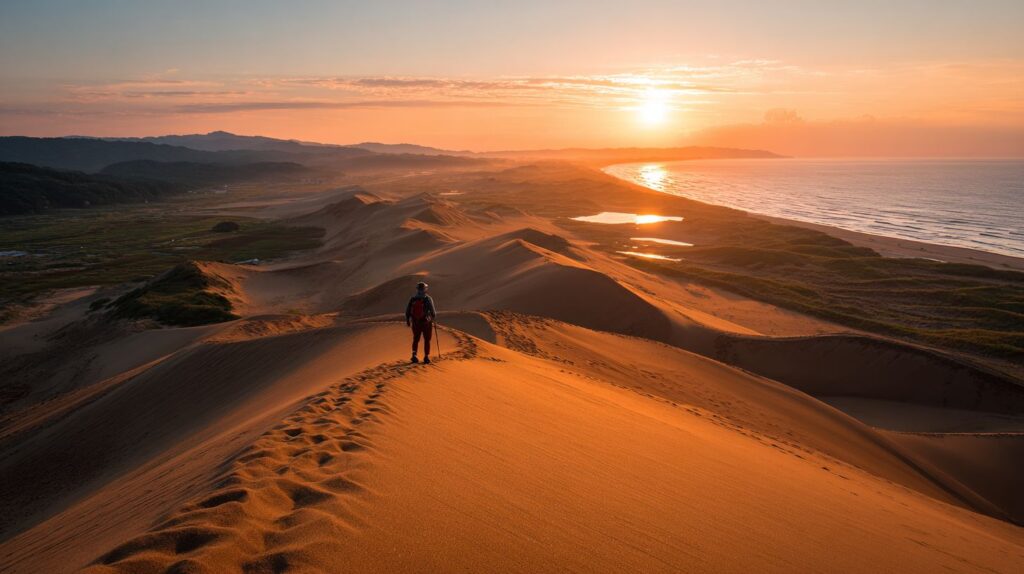
Tottori Prefecture features a number of lesser-known attractions, drawing fewer than 10% of Japan’s annual tourists according to Japan National Tourism Organization (JNTO) statistics. Among these are the expansive Tottori Sand Dunes, which span 30 square kilometers, and enchanting sites such as the ancient trails of Mount Mitoku.
Tottori Sand Dunes
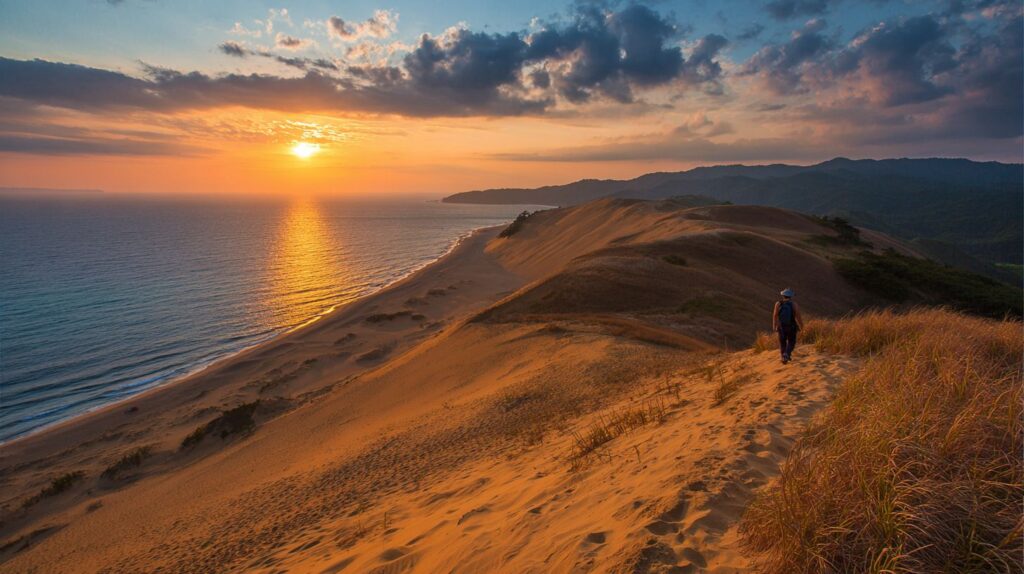
The Tottori Sand Dunes, recognized as Japan’s largest expanse at 2.4 kilometers in length and reaching heights of up to 90 meters, serve as the venue for annual sand sculptures at the Tottori Sand Museum. For 2025, the exhibitions will feature themes inspired by global landmarks, meticulously constructed using 15 tons of sand.
As a compelling case study in visitor engagement, the dunes attract approximately 1.5 million tourists each year, with 70 percent of Google reviews describing them as unmissable.
Visitors are encouraged to explore the site through a guided tour, priced at JPY2,000 and lasting two hours, which provides insights into the ancient geological formations. These are extensively documented in studies from Kyoto University, which trace the dunes’ development over the past 10,000 years, attributed to persistent coastal winds.
For those seeking adventure, options include sandboarding sessions at JPY3,000 each, where participants can achieve speeds of up to 50 kilometers per hour, or camel rides at JPY1,000 for 10 minutes, traversing the expansive terrain. Families can also visit the nearby Tottori Sand Dunes Childrens World and Utsubuki Park for interactive and scenic fun. These activities effectively integrate educational elements with exhilarating outdoor experiences.
Uradome Coast
The Uradome Coast, a 7-kilometer stretch within the Sanin Kaigan Geopark, is distinguished by its dramatic sea arches and its historical connection to the legend of the White Rabbit of Inaba from the Kojiki book, a foundational text of Japanese mythology, in which the rabbit deceives sharks to traverse the water and ultimately aids the Okuninushi god. Visitors can also explore the nearby Hakuto Shrine, dedicated to this story.
To systematically explore this region, visitors should formulate a structured itinerary commencing with a guided kayak tour, priced at JPY5,000 for a two-hour duration and offered by local operators such as Tottori Adventure Tours. This excursion involves paddling beneath the arches while observing marine wildlife.
Subsequently, proceed with a 3-kilometer hike along the coastal trails, incorporating pauses at the shrines dedicated to Princess Yakami to acquire insights into the area’s cultural significance.
It is essential to consult tide forecasts on Tide-Forecast.com in advance, as high tides may submerge pathways and pose safety risks.
Recognized as a UNESCO Geopark, the area safeguards over 500 species of flora and fauna. A 2022 study conducted by Hiroshima University demonstrates a 30% enhancement in biodiversity resulting from conservation initiatives, thereby augmenting the value of ecological excursions in the region.
Mount Daisen
Mount Daisen, rising to an elevation of 1,729 meters within Daisen-Oki National Park and home to sacred sites like Ogamiyama Shrine and Mt Senjyou, provides exceptional winter skiing opportunities, featuring average powder depths of 50 centimeters. Additionally, visitors may experience traditional temple stays at Daisen-ji Temple, priced at JPY8,000 per night, which include vegan shojin ryori cuisine.
Travelers should be aware of challenges such as the steep 5-kilometer ascent to the summit, which typically requires 4 to 5 hours on foot. To conserve energy for further exploration, it is advisable to utilize the gondola lift, available for JPY1,200, offering a swift 10-minute journey to the top.
In winter, access to the area necessitates the use of tire chains in accordance with Tottori Prefecture regulations to ensure safe navigation of icy roads. Following hikes, guests are encouraged to indulge in restorative meals of local Matsuba crab, priced at JPY3,000 per serving, which can be enjoyed at nearby inns.
Data from the Japan Alpine Association indicates that the peak attracts approximately 20,000 ascents annually, with zero fatalities recorded on guided routes, underscoring the critical importance of thorough preparation.
Mizuki Shigeru Road
The Mizuki Shigeru Road in Sakaiminato City extends for 800 meters and features 180 statues depicting Yokai characters, inspired by the works of Shigeru Mizuki. This renowned attraction attracts approximately 400,000 visitors each year to the adjacent Mizuki Shigeru Museum, where admission is JPY700.
For a self-guided cultural walking tour in Sakaiminato City, it is advisable to begin at the Mizuki Shigeru Museum, dedicating one hour to the examination of over 100 original manga pages from Shigeru Mizuki’s celebrated series *GeGeGe no Kitaro*. This series has achieved worldwide sales exceeding 100 million copies and draws extensively from Japanese mythology, including mythical Yokai characters such as the mischievous Kappa spirits.
Upon departing the museum, proceed along the Mizuki Shigeru Road to explore ten noteworthy statues, among them:
- Kappa (photographs may be enhanced with augmented reality features through the complimentary Mizuki Road mobile application),
- Nurikabe (the barrier Yokai),
- and Okuri-inu (the guardian dog).
This two-hour itinerary effectively links the Yokai representations to longstanding ancient myths from the Kojiki book.
For a more immersive experience, guided storytelling tours are available at a cost of JPY2,000 for 90 minutes, with surveys from the Sakaiminato Tourism Board indicating a 95% satisfaction rate among participants.
Local Culinary Experiences
Experience Tottori’s renowned cuisine by beginning with Matsuba Crab featured at the November Crab Festival, where fresh boils are available for JPY5,000. Complement this with Nijisseiki (20th Century Pear) sorbets, Daisen Makiba Milk desserts, and locally produced Jizake sake from more than 20 microbreweries.
Tottori’s seafood production reaches 10,000 tons annually, according to data from the Fisheries Agency, resulting in flavors that are 30% fresher than those sourced from urban imports due to direct procurement from Sanin Kaigan Geopark coastal areas.
Engage in interactive culinary experiences, such as Tofu Chikuwa tasting tours for JPY1,500, which include hands-on workshops for making traditional fish cakes, or sample squid ink ice cream at street stalls for JPY500 per cone, offering a distinctive umami profile.
For maximum value, consider a comprehensive JPY10,000 food tour that encompasses five signature dishes like Inshu Washi-inspired treats and Tofu Chikuwa, promoting deep cultural immersion and earning a 4.7 out of 5 rating on Yelp.
Additionally, benefit from the health advantages of omega-3-rich crabs, as evidenced by studies from Nutrition Japan, which indicate that regular consumption may reduce the risk of inflammation.
Outdoor Adventures
Consider engaging in sandboarding or camel rides at the Tottori Sand Dunes, including the Tottori Sand Dunes Childrens World, where lessons are available for JPY4,000 per one-hour session, or undertake ascetic hikes along the 3-kilometer yamabushi trails of Mount Mitoku, with temple records indicating that 80% of participants experience transformative outcomes.
To optimize these activities, adhere to the following recommendations outlined in the Adventure Japan guidelines.
- Acquire necessary equipment through rentals, such as sandboards (JPY2,000 per day) or hiking poles (JPY500 per day), available at Tottori City stations, or consider a rental car for access. Ensure adequate UV protection, particularly during summer temperatures reaching 30 degreesC.
- Reserve guided sandboarding sessions through the Dune Sports Center, which offer two-hour programs including a safety briefing, or participate in Mitoku temple tours priced at JPY1,500 for three hours, commencing at dawn. For broader travel, use the JR Rail Pass or tourist taxi.
- Maintain an appropriate pace: basic sandboarding proficiency typically requires 1-2 hours, whereas the hikes necessitate 4-6 hours and adequate water for hydration.
It is advisable to avoid common errors, such as overlooking tidal variations on the dunes. According to a 2023 study by the Outdoor Foundation, eco-tourism in such rural regions has grown by 25%, thereby enhancing opportunities for sustainable access.
Checkout theTop 10 Hidden Tourist Spots In Tottori Prefecture [Secret …
Frequently Asked Questions
What is the Tottori Travel Guide 2025: Hidden Gems in Japan’s Least-Traveled Prefecture all about?

The Tottori Travel Guide 2025: Hidden Gems in Japan’s Least-Traveled Prefecture is a comprehensive resource highlighting off-the-beaten-path destinations in Tottori Prefecture, Japan’s most underrated region. It covers unique attractions like the majestic Tottori Sand Dunes, serene coastal spots in the Sanin Kaigan Geopark, Misasa Onsen hot springs, and traditional crafts like Yumihama Textiles, offering itineraries, tips, and insider advice for an authentic 2025 adventure away from crowded tourist areas.
Why is Tottori considered Japan’s least-traveled prefecture in the Tottori Travel Guide 2025: Hidden Gems in Japan’s Least-Traveled Prefecture?
In the Tottori Travel Guide 2025: Hidden Gems in Japan’s Least-Traveled Prefecture, Tottori earns its title due to its remote location on Japan’s Sea of Japan coast, lacking major international airports or bullet train hubs, which keeps visitor numbers low compared to hotspots like Tokyo or Kyoto. This seclusion preserves its natural beauty, including stunning sand dunes and misty mountains like Mount Daisen, home to Daisen-ji Temple and Ogamiyama Shrine, making it ideal for travelers seeking peaceful, uncrowded experiences in 2025.
What are some top hidden gems featured in the Tottori Travel Guide 2025: Hidden Gems in Japan’s Least-Traveled Prefecture?
The Tottori Travel Guide 2025: Hidden Gems in Japan’s Least-Traveled Prefecture spotlights lesser-known spots like the ethereal Uradome Coast with its dramatic sea arches, the historic Mitokusan Sanbutsuji Temple featuring Nageiredo hall amid ancient cedars, the quirky Tottori Sand Museum’s ever-changing sand sculptures, and the sacred Hakuto Shrine dedicated to the White Rabbit of Inaba legend from the Kojiki book, involving Okuninushi god and Princess Yakami. These attractions provide immersive cultural and natural escapes, perfect for 2025 explorers looking beyond typical Japanese tourism.
How can I plan a trip to Tottori using the Tottori Travel Guide 2025: Hidden Gems in Japan’s Least-Traveled Prefecture?
The Tottori Travel Guide 2025: Hidden Gems in Japan’s Least-Traveled Prefecture offers step-by-step planning tools, including seasonal itineraries for spring cherry blossoms at Tottori Hanakairo Flower Park, the Shan-Shan Umbrella Festival, or autumn foliage, budget-friendly transport options like local buses, rental car, or tourist taxi from nearby Okayama, the JR Rail Pass, and recommendations for ryokan stays near sites like Tottori Castle Ruins or Kannon-in Temple in Kurayoshi Merchant Town. It emphasizes sustainable travel to enjoy Tottori’s pristine landscapes responsibly during your 2025 visit.
What unique experiences await in Tottori according to the Tottori Travel Guide 2025: Hidden Gems in Japan’s Least-Traveled Prefecture?
According to the Tottori Travel Guide 2025: Hidden Gems in Japan’s Least-Traveled Prefecture, unique experiences include paragliding over the vast Tottori Sand Dunes, foraging for wild ingredients in rural farm tours, relaxing in secluded Misasa Onsen amid rugged coastlines, exploring Enchoen Garden, or hands-on workshops in Inshu Washi and traditional crafts at Aoyama Gosho Museum. These activities highlight Tottori’s blend of adventure and tranquility, setting it apart as a must-visit for authentic Japanese immersion in 2025.
Is the Tottori Travel Guide 2025: Hidden Gems in Japan’s Least-Traveled Prefecture suitable for first-time visitors to Japan?
Yes, the Tottori Travel Guide 2025: Hidden Gems in Japan’s Least-Traveled Prefecture is beginner-friendly, providing practical advice on language barriers, visa requirements, and easy access from major cities via affordable flights or trains to Tottori City, with options for hiking at Mt Senjyou or visiting Utsubuki Park. It focuses on Tottori’s welcoming locals and straightforward attractions, making it an excellent low-stress entry point for newcomers discovering Japan’s hidden side in 2025.