You’re probably wondering how renewable energy will keep powering our world as demands grow. This look at 2026 highlights advances in solar power and wind energy, plus energy storage and grid tech that make clean energy more reliable. It’s the straightforward update you need on what’s coming next.
Table of Contents
Key Takeaways:
- Perovskite solar cells and bifacial panels will boost efficiency beyond 30%, slashing costs and enabling widespread rooftop adoption by 2026.
- Floating offshore turbines and airborne wind systems unlock vast ocean wind resources, powering millions with minimal land use.
- Solid-state batteries, green hydrogen, and AI optimization will store and distribute clean power reliably, accelerating the shift to 100% renewables.
Solar Power Advancements
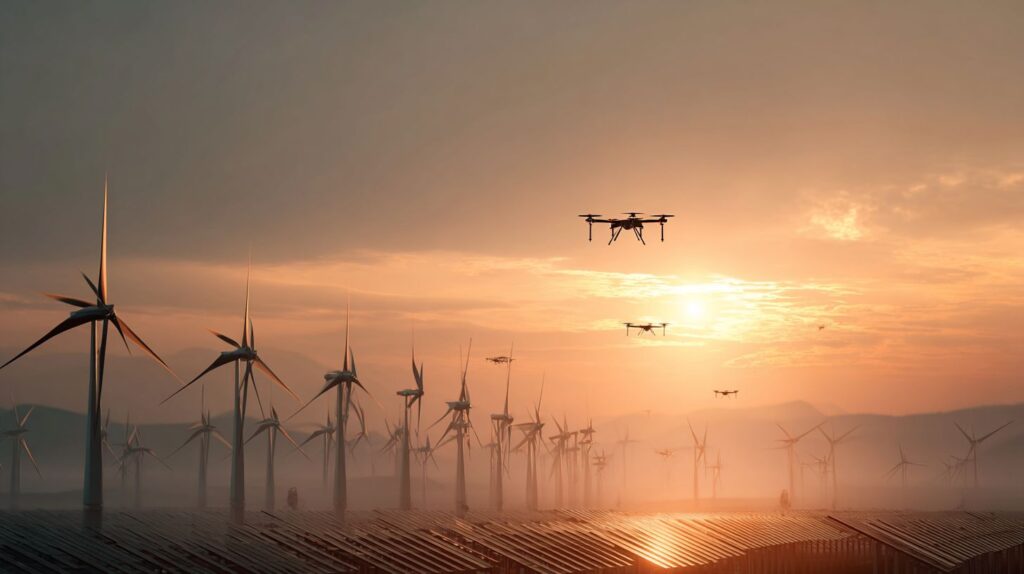
Solar power continues to lead renewable energy growth through technological innovations in efficiency and deployment flexibility. Solar PV plays a central role in electricity generation, powering homes, businesses, and grids worldwide. Its scalability supports the shift toward clean energy amid the energy transition.
Recent innovations focus on technological innovations like advanced materials and designs that boost output without relying on vast land areas. These advancements align with market trends in PV manufacturing, especially from leaders in China. Business leaders can track global capacity growth to inform investment decisions.
Key developments emphasize sustainability through better resource use and integration with energy storage. This positions solar PV as a cornerstone for net zero and carbon neutrality goals. Experts recommend monitoring policy landscape that favor such capacity growth.
From urban rooftops to floating arrays, these technologies expand solar’s reach. They reduce dependence on fossil fuels and enhance grid integration. Practical applications demonstrate real-world viability for diverse sectors.
Perovskite Solar Cells
Perovskite cells promise to revolutionize solar power with lab efficiencies exceeding traditional silicon limits. These cells use a perovskite-silicon tandem structure, layering perovskite on silicon to capture more sunlight spectrum. Developments from LONGi and NREL highlight this approach’s potential.
The tandem design works by having the top perovskite layer absorb higher-energy light, while silicon handles the rest. This boosts overall performance compared to single-junction panels. Stability improvements, like better encapsulation, address earlier degradation issues from moisture and heat.
Manufacturing scalability remains a challenge due to uniform coating needs at gigawatt scale. Solutions involve roll-to-roll printing for cost-effective production. Commercial timelines point to pilots by 2026, with full deployment following 2030.
| Technology | Efficiency Trend | Key Advantage |
|---|---|---|
| Traditional Silicon | Stable plateau | Proven durability |
| Perovskite Tandem | Rising curve | Wider light capture |
Business leaders tracking PV manufacturing trends should prioritize suppliers advancing perovskite tech. Actionable insights include auditing supply chains for tandem readiness. This prepares for shifts in the investment landscape.
Flexible and Bifacial Panels
Flexible and bifacial panels expand solar power applications to unconventional surfaces and environments. Bifacial designs capture sunlight on both sides, with the rear gaining energy from reflected light for higher yields than standard panels. This makes them ideal for ground-mounted or elevated installs.
Floating PV deployments on water bodies like reservoirs cool panels naturally, improving energy efficiency. Flexible panels conform to curved rooftops or building facades, fitting urban settings. Case studies from non-residential sites, such as factories and canals, show versatile use.
Installation considerations include securing bifacial panels for optimal tilt and ground reflectivity. For floating systems, anchor stability and water compatibility matter. Cost-benefit analysis weighs initial setup against long-term output gains.
- Select high-albedo surfaces for bifacial yield boosts.
- Assess site curvature for flexible panel fit.
- Factor maintenance access in water-based setups.
- Model energy gains using rear-side irradiance tools.
Business leaders can template analyses by comparing lifecycle costs to traditional panels. These technologies support sustainability in hybrid systems with energy storage. They drive electricity share from renewables forward.
Wind Energy Innovations
Wind energy innovations unlock higher capacity factors and access to untapped wind resources worldwide. These advances help wind turbines boost their share of global electricity generation amid the push for clean energy. They address limits of traditional designs in low-wind areas and deep waters.
Floating offshore turbines and airborne systems lead the charge in technological innovations. Floating platforms enable deployment in deeper seas, while airborne concepts reach steadier winds aloft. Both promise greater reliability for the energy transition.
Business leaders eye these for offshore wind expansion and hybrid systems with energy storage. Projects in EU highlight scaling potential, drawing investment in the policy landscape favoring net zero goals. Supply chains must adapt for gigawatt-scale output.
Experts recommend pairing these with AI optimization for predictive maintenance. Such steps enhance grid integration and sustainability in renewable energy mixes.
Floating Offshore Turbines
Floating offshore turbines tap deep-water wind resources beyond fixed-foundation limits. These designs use mooring systems to anchor platforms in waters too deep for bottom-fixed structures. They open vast areas for offshore wind farms.
Key platform types include spar, semi-submersible, and tension-leg designs. Spar platforms sink deep for stability, while semi-submersibles offer easier towing to site. Dynamic cables manage motion to transmit power reliably.
Levelized cost of energy trends show floating turbines closing the gap with fixed-bottom ones as designs mature. EU waters host growing project pipelines, from pilots to commercial arrays. Gigawatt-scale deployments demand robust supply chains for towers, blades, and assembly.
- Spar platforms suit stable seas with deep drafts.
- Semi-submersibles provide flexibility for varied sites.
- Mooring innovations reduce fatigue on dynamic cables.
Business leaders should assess local ports for manufacturing. Integration with green hydrogen production enhances value in carbon neutrality efforts.
Airborne Wind Systems
Airborne wind systems elevate turbines to stronger, more consistent high-altitude winds. Kite, balloon, and drone-based designs use tethers for power transmission and control. They bypass terrain limits of ground-based wind turbines.
Kites generate power through ground stations as they cycle altitude. Balloon systems stay aloft with helium, harvesting steady winds. Drones or gliders add mobility for optimal positioning.
Regulatory hurdles involve airspace rules and safety certifications. Scaling challenges include tether durability and energy yield consistency. Pilot projects demonstrate metrics like uptime and output in real conditions.
| Aspect | Airborne Systems | Ground-Based Turbines |
|---|---|---|
| Wind Access | High-altitude steady flows | Surface-level variable winds |
| Footprint | Minimal land use | Large foundations needed |
| Risk Profile | High due to tech novelty | Proven but site-limited |
For business leaders evaluating high-risk innovations, pilots offer proof points. Pairing with digital technologies aids grid integration in microgrids.
Energy Storage Breakthroughs
Energy storage breakthroughs enable renewable energy reliability at utility scale. These advances address the intermittent nature of solar power, wind energy, hydro power, and geothermal energy, ensuring steady supply to the grid. Storage systems smooth out fluctuations for better grid integration.
Modern batteries capture excess power during peak production. They release it during high demand, supporting net zero goals. This balances geothermal energy and hydro power with daily cycles.
Utility-scale projects now pair storage with hybrid systems. For instance, wind turbines connect to batteries for constant output. These setups cut reliance on fossil fuels.
Experts recommend scaling storage alongside capacity growth in clean energy. This drives the energy transition toward carbon neutrality. Innovations make renewables viable for baseload power.
Solid-State Batteries

Solid-state batteries replace liquid electrolytes with ceramics or polymers for superior safety and density. They use a lithium-metal anode that boosts energy capacity over traditional designs. This shift enhances performance in renewable energy applications, alongside bioenergy, pumped storage, heat pumps, electrolyzers, biogas plants, and sustainable aviation fuel.
The lithium-metal anode offers higher energy density than lithium-ion cells. It supports more charge cycles, ideal for long-term grid use. Dendrite suppression comes from solid electrolytes that block metal spikes during charging.
Solid-state designs show better cycle life with less degradation over time. Compared to lithium-ion, they pack more energy per weight, aiding microgrids and remote sites. Research from NREL suggests these batteries excel in harsh conditions.
Manufacturing hurdles include scaling solid electrolyte layers and cost control, especially in China. High temperatures in production slow adoption. Experts recommend partnering with vetted suppliers for pilot projects.
For energy storage projects, use this procurement checklist:
- Verify energy density specs exceed 400 Wh/kg targets.
- Confirm cycle life ratings for 5,000+ full cycles.
- Assess dendrite-resistant certifications from third parties.
- Evaluate thermal runaway prevention in safety tests.
Address supply chain risk assessments by diversifying sources beyond China for raw materials. Map dependencies on rare earths and audit factory outputs. This ensures reliable delivery for gigawatt scale deployments.
Green Hydrogen Technologies
Green hydrogen technologies scale electrolyzers to produce clean fuel from renewable electricity. This process splits water using power from sources like solar power and wind energy. It supports the energy transition toward net zero goals.
Key choices include PEM electrolyzers and alkaline electrolyzers. PEM units offer fast response times for variable renewable inputs, while alkaline types handle larger scales at lower costs. Tradeoffs depend on project needs like grid integration.
Stack degradation mitigation uses predictive maintenance and material coatings to extend life. Balance-of-plant optimization improves efficiency through better pumps and heat recovery systems. These steps cut long-term expenses in industrial heat applications.
Applications span SAF production for aviation and high-temperature processes in steelmaking. Policy incentives shape the investment landscape, with governments offering tax credits for green hydrogen projects. Track these via dedicated portals for planning.
PEM vs. Alkaline Electrolyzer Tradeoffs
PEM electrolyzers excel in dynamic operation, ramping quickly with fluctuating wind energy or solar PV output. They use solid polymer membranes for compact designs. However, they require purer water and face higher material costs.
Alkaline electrolyzers rely on liquid electrolytes for proven durability at gigawatt scale. They operate at lower voltages, reducing electricity needs from hydro power or geothermal energy. Drawbacks include slower start-up times unsuitable for microgrids.
Choose PEM for hybrid systems with energy storage, and alkaline for steady baseload from bioenergy. Experts recommend hybrid setups combining both for optimal grid integration. This balances cost and flexibility in clean energy projects.
Stack Degradation Mitigation
Stack degradation shortens electrolyzer life from impurities and overuse. Mitigation starts with water purification systems to prevent membrane fouling. Regular monitoring via sensors detects early wear in solar PV integrated systems.
Advanced coatings on electrodes resist corrosion in harsh conditions. AI optimization predicts failure by analyzing voltage drops. Operators schedule maintenance during low-demand periods from renewable sources.
These strategies extend stacks to over a decade, vital for sustainability. Pair with digital technologies for real-time adjustments. This keeps opex low in large facilities tied to offshore wind or floating PV.
Balance-of-Plant Optimization
Balance-of-plant covers supporting systems like compressors and dryers. Optimization focuses on energy efficiency through heat pumps for waste recovery. This boosts overall yield from input electricity.
Modular designs allow scaling with capacity growth in PV manufacturing hubs like China. Integrate gas storage for steady output despite variable inputs. Software simulates flows to minimize losses.
Resulting savings compound in circular economy setups with recycling panels. Track metrics like specific energy consumption for continuous improvement. This positions projects for carbon neutrality.
Capex/Opex Modeling and Policy Incentives
Capex modeling templates assess upfront costs for electrolyzers and infrastructure. Factor in site prep, power links, and permitting for wind turbines or biogas plants. Simple spreadsheets track sensitivities to metal prices amid 2024 global capacity reaching 4448 GW.
Opex includes maintenance, water, and electricity from renewables as warned by Bill McKibben. Use lifetime projections to forecast cash flows. Adjust for market trends like falling solar costs and the Inflation Reduction Act.
- Input electrolyzer efficiency and stack life.
- Model renewable electricity share from hydro power or pumped storage.
- Apply policy incentives like production tax credits.
Policy tracking tools monitor global incentives for technological innovations. Regions like the EU, US, and India push subsidies for SAF production amid climate emergency. This informs business leaders on viable investments replacing fossil fuels.
Nuclear Fusion Progress
Nuclear fusion progress brings net energy gain closer to commercial reality. Key approaches like tokamaks, stellarators, and inertial confinement show promising milestones per CleanTechnica. These methods aim to replicate the sun’s power through controlled reactions.
Tokamaks use magnetic fields to contain plasma in a doughnut shape, as seen in projects worldwide. Stellarators offer steadier confinement with twisted coils, reducing instability risks. Inertial confinement lasers compress fuel pellets for brief, intense fusion bursts.
The Q>1 physics threshold marks when fusion output exceeds input energy, a critical step for viability. Materials must endure extreme heat and neutron bombardment without degrading. Experts recommend advanced alloys and cooling systems to tackle these challenges.
ITER sets an international roadmap toward demonstration plants, paving the way for private ventures like Commonwealth Fusion Systems and LONGi. These firms target compact reactors using high-temperature superconductors. Business leaders should eye grid integration timelines in the early 2030s for clean energy scaling with 10.3 TW potential.
Geothermal and Ocean Energy

Geothermal and ocean energy harness earth’s constant heat and endless wave motion. These sources offer baseload clean energy potential, providing steady power unlike variable solar power or wind energy. They support the energy transition by delivering reliable electricity generation around the clock.
Ocean technologies tap into waves, tides, and thermal gradients for consistent output. Geothermal pulls heat from deep rock layers, ideal for net zero goals. Both connect with energy storage and grid systems to replace fossil fuels.
Next-gen advances in geothermal energy focus on expanding access beyond natural hot springs. Ocean energy pilots, including vertical axis designs, show promise in coastal regions, aiding global capacity growth like 260 GW solar, 117 GW wind, and 24.6 GW hydro. These fit into the broader renewable energy mix with hydro power and bioenergy.
Experts recommend combining them in hybrid systems for better dispatchability. This approach enhances sustainability and supports policy landscapes pushing carbon neutrality. Practical sites near population centers speed deployment.
Enhanced Geothermal Systems
Enhanced geothermal systems fracture hot dry rock formations to create artificial reservoirs. Hydraulic stimulation techniques inject water under pressure to open fractures, allowing heat extraction. This mimics natural geothermal but accesses wider areas.
Reservoir modeling with digital technologies uses AI optimization to predict fluid flow and heat transfer. Seismic monitoring protocols track activity in real time, ensuring safety. These tools improve efficiency over traditional methods.
Compared to hydro power’s dispatchability, enhanced systems offer similar reliability without weather dependence. Site selection criteria include rock permeability, depth of hot zones, and proximity to grids. Experts recommend areas with existing infrastructure for faster rollout.
- Evaluate geological surveys for heat gradients above 150 degrees Celsius.
- Assess water availability for stimulation and circulation.
- Review seismic history to minimize risks.
- Prioritize sites near demand centers to cut transmission losses.
Permitting timelines for energy transition projects vary by region but speed up with clear environmental plans. Projects in volcanic zones often advance quicker. This technology boosts clean energy shares alongside ocean and wind turbines.
Grid Modernization and AI Integration
Grid modernization with AI optimization transforms renewable energy integration from challenge to advantage. Utilities deploy wide-area monitoring to track grid conditions in real time across vast regions like 1136 GW wind capacity and 1443 GW hydro capacity. This approach uses sensors and data analytics to balance solar PV and wind energy inputs effectively.
Dynamic line rating adjusts transmission capacity based on weather and line conditions. It allows grids to carry more power during favorable times, supporting energy storage and green hydrogen projects. Virtual power plants aggregate distributed resources like rooftop solar and batteries into a unified system.
AI drives predictive maintenance for wind turbines and solar PV by analyzing sensor data for early AI optimization. This reduces downtime and extends equipment life in the push toward net zero. Experts recommend starting with pilot programs on existing infrastructure.
Implementation roadmaps include phased sensor deployment, AI model training, and staff upskilling. Cybersecurity frameworks feature encryption, anomaly detection, and regular audits to protect against threats. Utilities pursuing carbon neutrality see strong ROI through lower outages and efficient grid integration.
Wide-Area Monitoring and Dynamic Line Rating
Wide-area monitoring employs phasor measurement units to provide grid-wide visibility. It detects instability early, enabling quick responses to fluctuations from offshore wind or geothermal energy. This technology enhances reliability as renewable energy grows.
Dynamic line rating uses real-time data on temperature, wind speed, and sag to optimize line usage. Grids handle higher loads from pumped storage or bioenergy plants without new infrastructure. Operators, including those from China, adjust ratings dynamically for safer, more efficient power flow.
Combine these with virtual power plants to coordinate microgrids and demand response. Practical steps involve mapping high-renewable zones first. Such integrations support energy transition by maximizing existing assets.
AI for Predictive Maintenance
AI algorithms process vibration, temperature, and performance data from wind turbines. They predict failures in blades or gearboxes, scheduling repairs proactively. This cuts costs for solar power inverters and panels too.
For solar PV, AI identifies soiling or shading issues via drone imagery and satellite data. Maintenance teams focus on high-risk areas, improving output. Research suggests these tools boost uptime across hybrid systems.
Start with cloud-based platforms for data collection and analysis. Train models on historical faults for accuracy. Utilities gain from fewer emergency fixes and longer asset life.
Implementation Roadmaps and Cybersecurity
Roadmaps begin with assessing current grid data flows and gaps. Phase one installs sensors on key lines; phase two integrates AI dashboards. Align with policy landscape for funding in clean energy.
- Conduct audits of legacy systems.
- Pilot digital technologies in one region.
- Scale with vendor partnerships.
- Monitor KPIs like response time.
Cybersecurity frameworks use multi-layer defenses, including AI-driven threat hunting. Segment networks to isolate electrolyzers or biogas plants. Regular simulations build resilience against attacks.
ROI Case Studies for Net Zero
Utilities adopting these technologies report operational savings from optimized electricity generation. One example reduced turbine downtime through AI predictions, freeing capacity for floating PV with 4448 GW potential. Investments pay back via avoided upgrades.
Virtual power plants enable energy efficiency by peaking shaving and valley filling. Cybersecurity investments prevent costly breaches, supporting sustainability goals. Net zero paths accelerate with these tools.
Focus on measurable outcomes like reduced maintenance spend. Pair with recycling panels for full lifecycle gains. Business leaders prioritize such modernizations for competitive edges in the investment landscape.
Frequently Asked Questions
What is “The Future of Clean Power: Emerging Technologies in Renewable Energy for 2026” all about?

“The Future of Clean Power: Emerging Technologies in Renewable Energy for 2026” refers to the anticipated advancements in renewable energy sources set to transform global power generation by 2026, targeting 10.3 TW. It highlights innovations like next-gen solar panels from LONGi, advanced wind turbines, and green hydrogen systems aimed at reducing carbon emissions and enhancing energy efficiency.
Which emerging technologies will define The Future of Clean Power: Emerging Technologies in Renewable Energy for 2026?
Key technologies shaping The Future of Clean Power: Emerging Technologies in Renewable Energy for 2026 include perovskite solar cells for higher efficiency, floating offshore wind farms, solid-state batteries for better energy storage, PV manufacturing advances, and AI-optimized smart grids to integrate renewables seamlessly into existing infrastructure.
How will solar power evolve in The Future of Clean Power: Emerging Technologies in Renewable Energy for 2026?
In The Future of Clean Power: Emerging Technologies in Renewable Energy for 2026, solar power will see breakthroughs like tandem solar cells achieving over 30% efficiency, bifacial panels that capture sunlight from both sides, reaching 260 GW solar, 117 GW wind, and 24.6 GW hydro, making solar more viable in diverse climates and reducing costs significantly.
What role does energy storage play in The Future of Clean Power: Emerging Technologies in Renewable Energy for 2026?
Energy storage is pivotal in The Future of Clean Power: Emerging Technologies in Renewable Energy for 2026, with innovations such as flow batteries and gravity-based systems enabling 24/7 renewable power availability with projected 585 GW, addressing intermittency issues and supporting grid stability per NREL.
Can green hydrogen become mainstream by The Future of Clean Power: Emerging Technologies in Renewable Energy for 2026?
Yes, green hydrogen is poised to go mainstream in The Future of Clean Power: Emerging Technologies in Renewable Energy for 2026, thanks to electrolyzer cost reductions, scalable production using excess renewable energy, and integration with SAF production, powering industries, transport, and heavy machinery sustainably.
What challenges must be overcome for The Future of Clean Power: Emerging Technologies in Renewable Energy for 2026?
Challenges for The Future of Clean Power: Emerging Technologies in Renewable Energy for 2026 include supply chain issues for rare earth materials, regulatory hurdles for deployment, and the need for massive infrastructure investments to reach 1136 GW wind capacity and 1443 GW hydro capacity, but global collaborations like the Inflation Reduction Act and policy incentives are accelerating progress, as noted by Bill McKibben in CleanTechnica.