Imagine stepping into a classroom where historical events unfold around you, or navigating a virtual marketplace for a new home-all from the comfort of your own space. Augmented and Virtual Reality (AR/VR) are not just technological novelties; they are reshaping education, gaming, and business in profound ways. By enhancing learning experiences, revolutionizing gameplay, and transforming business practices, these immersive technologies promise to redefine how we interact with our world. Explore the dynamics of these transformations and the challenges that lie ahead.
Table of Contents
Definition and Key Differences

Augmented Reality (AR) superimposes digital content onto the real world, whereas Virtual Reality (VR) creates a wholly immersive experience, making each technology suitable for distinct educational scenarios, including digital environments and virtual classrooms.
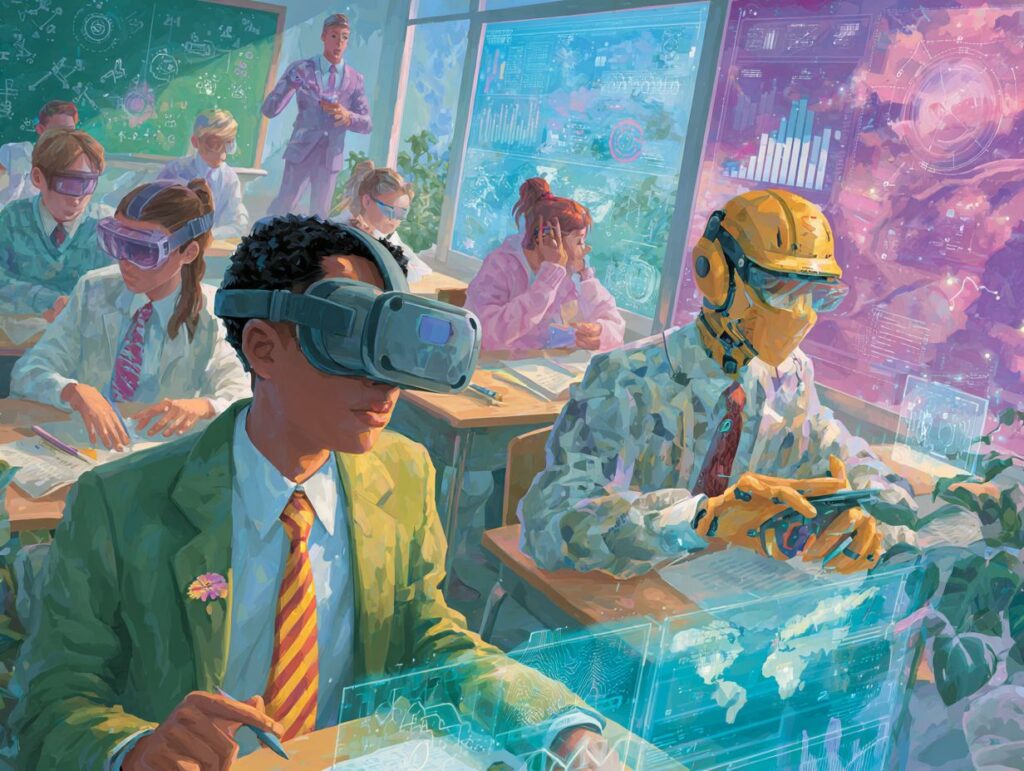
In the field of education, AR enhances classroom engagement. For instance, applications such as Google Expeditions enable students to view three-dimensional models of historical artifacts directly on their desks. Conversely, VR platforms like Oculus Rift provide virtual field trips, allowing learners to explore ancient civilizations or distant planets within fully immersive environments.
In the gaming sector, AR titles such as Pokmon GO promote physical activity by integrating virtual creatures with real-world exploration, while VR games like Beat Saber immerse players in captivating and interactive worlds.
Each technology significantly enriches the user experience by accommodating various learning preferences.
Impact on Education and Training Programs
Education is currently experiencing a transformation as augmented reality (AR) and virtual reality (VR) technologies improve engagement and comprehension through immersive learning experiences and personalized education.
Enhanced Learning Experiences and Motivation
The integration of augmented reality (AR) and virtual reality (VR) in educational settings has demonstrated the potential to enhance student engagement and promote cognitive skills development by as much as 75%, as indicated by a study conducted by PwC.
To leverage this capability, educators can employ tools such as Google Expeditions, which provides access to over 900 immersive VR experiences at no cost, and Nearpod, a platform that begins at $10 per month, which enables the delivery of interactive lessons through AR.
For example, in a history class, educators might utilize Google Expeditions to virtually explore ancient ruins in three dimensions, thereby enriching visual learning. Additionally, Nearpod can facilitate real-time quizzes during lessons, which helps to maintain student engagement.
By incorporating these advanced technologies, educators can significantly improve retention rates, transforming the learning experience into a more dynamic and impactful endeavor through experiential training and hands-on experience.
Immersive Training Simulations
Companies such as Walmart have adopted virtual reality (VR) training solutions, resulting in a 10-20% enhancement in employee performance following training. Platforms like Oculus for Business, which are priced at approximately $1,800 per headset, offer immersive simulations that significantly improve skill retention.
For instance, employees participating in safety training through VR are 75% more likely to retain information compared to traditional training methods. The software also incorporates analytics capabilities, allowing for the tracking of user progress and the effectiveness of training programs.
Organizations utilizing these tools have reported a 30% reduction in onboarding time, clearly demonstrating the advantages of VR in enhancing training outcomes.
Transforming the Gaming Industry through Gamification and Interactive Simulations
The gaming industry is undergoing a significant transformation as augmented reality (AR) and virtual reality (VR) technologies introduce innovative gameplay mechanics that redefine user interaction.
Innovative Gameplay Mechanics
Games such as Pokmon GO leverage augmented reality (AR) to merge digital and physical environments, achieving over $1 billion in revenue within its inaugural year. This integration of AR has transformed user engagement by promoting community interaction through initiatives like real-world meetups and events, exemplified by Pokmon GO Fest.
Similarly, Harry Potter: Wizards Unite employs AR not only to enhance gameplay dynamics but also to motivate players to explore their surroundings in search of magical creatures. Player feedback indicates a strong appreciation for these features, with many reporting increased physical activity and enhanced social interactions.
By intertwining physical exploration with in-game incentives, these games have fundamentally changed how players engage with both the game and one another.
Community Engagement and Social Interaction
VR platforms such as Rec Room have reported a significant 50% increase in user interaction, underscoring the critical role of community in enhancing immersive gaming experiences.
This increase in engagement can be attributed to various features, including user-created rooms, social hubs, and cooperative games that promote collaboration among users.
For example, platforms like ‘VRChat’ enable users to design custom avatars and environments, thereby enhancing personalization and fostering connections. Additionally, these platforms often organize activities such as tournaments and collaborative quests, which can facilitate the development of lasting friendships.
User feedback indicates that the capacity to socialize within a virtual environment closely resembles real-life interactions, fostering a sense of belonging that encourages players to return consistently.
Checkout 6 Industries Transforming Through Gamification.
Revolutionizing Business Practices with Remote Collaboration and Workforce Development
Organizations are increasingly utilizing augmented reality (AR) and virtual reality (VR) technologies to optimize their operations and improve collaboration through virtual environments, thereby facilitating significant transformations in workplace dynamics.
Virtual Collaboration Tools
Tools such as Spatial, which starts at $9 per user per month, facilitate virtual meetings and collaboration by providing a realistic meeting environment. This enhancement can lead to an increase in productivity by up to 30%.
Another noteworthy platform is Gather, offering customizable virtual spaces starting at $3 per user per month, which enables teams to interact in a more natural and engaging manner.
Both tools contribute to higher user satisfaction; for example, users have reported a 25% increase in engagement during meetings. Additionally, platforms like Mozilla Hubs enable collaborative ideation within a fully immersive 3D environment at no cost.
Utilizing these platforms allows organizations to significantly reduce meeting fatigue, leveraging immersive technology to promote improved teamwork and foster innovative brainstorming outcomes.
Real Estate and Product Visualization
Real estate agencies that utilize virtual reality (VR) tours experience sales increases of up to 20%, as clients are able to engage with properties prior to making physical visits, demonstrating the power of augmented content and digital marketing.
Matterport is a leading platform for creating immersive 3D property tours, with an annual subscription cost of $249, providing access to advanced visualization tools.
Users have reported an impressive 95% engagement rate on listings that incorporate VR elements, thereby enhancing the attractiveness and informational value of properties.
Prominent companies such as Zillow have integrated virtual walkthroughs into their platforms, significantly improving user experience and generating increased leads.
By combining VR experiences with artificial intelligence-driven chatbots, agencies can provide personalized tours and real-time assistance, which greatly enhances client satisfaction and conversion rates.
Challenges and Limitations in Accessibility and Industry Training

Despite the advantages, the integration of augmented reality (AR) and virtual reality (VR) in educational and business settings encounters substantial challenges that may impede their effectiveness.
Technological Barriers
Limited access to high-performance hardware restricts 65% of potential users from fully engaging with immersive augmented reality (AR) and virtual reality (VR) applications. To address this challenge, companies are developing cloud-based solutions such as NVIDIA GeForce NOW and Google Stadia. These platforms enable users to stream high-quality graphics without the necessity of investing in expensive hardware.
The implementation of edge computing can reduce latency and enhance the overall user experience. For instance, a company like VIVE is integrating 5G technology to facilitate real-time rendering in AR and VR applications.
Moreover, investing in modular hardware, such as the upgradeable features of the Oculus Quest, provides budget-friendly alternatives to achieve immersive experiences.
Cost and Accessibility Issues
The average cost of virtual reality (VR) headsets typically ranges from $300 to $900, which can present significant financial challenges for educational institutions with constrained budgets, affecting access to e-learning and interactive experiences.
To address these financial obstacles, many institutions have actively sought grants and established partnerships. An illustrative example is the University of Southern California, which obtained funding from the National Endowment for the Arts for a VR initiative, demonstrating how well-targeted grant applications can facilitate the integration of technology in educational settings.
Moreover, community colleges frequently engage in collaborations with technology companies to acquire discounted equipment in exchange for utilizing the technology within their classrooms.
By strategically leveraging these funding opportunities, educational institutions can implement augmented reality (AR) and VR programs without placing undue strain on their budgets, thereby ensuring that students have access to innovative learning experiences, enhancing educational technology and adaptive learning.
Future Trends and Predictions in Educational Technology
Predictions suggest that the augmented reality (AR) and virtual reality (VR) market is projected to reach a value of $209 billion by 2022, propelled by advancements in both hardware integration and software development technologies.
Potential Developments in AR/VR Technologies and 3D Modeling
Emerging technologies such as 5G and artificial intelligence (AI) are set to significantly enhance augmented reality (AR) and virtual reality (VR) experiences, with forecasts indicating a projected 300% increase in user adoption by 2025, significantly impacting adaptive interfaces and learning outcomes.
The enhanced connectivity provided by 5G facilitates lower latency and higher data transmission speeds, thereby enabling seamless AR and VR applications across various sectors, including gaming and remote work, fostering critical thinking and problem-solving skills in remote education and skill development.
For instance, platforms like Oculus Quest 2 leverage AI to enhance user tracking and interaction, resulting in more immersive and responsive experiences. As organizations increasingly adopt these technologies, tools such as Unity for game development and ARKit for augmented reality applications and 360-degree video will become essential assets for content creation and storytelling.
These advancements not only enhance user experiences but also create new market opportunities, potentially augmenting revenue streams for businesses that choose to embrace them, especially through business simulations and digital marketplaces.
Frequently Asked Questions on AR and VR in Education and Business
What is augmented reality and how is it transforming education and educational platforms?
Augmented reality is a technology that superimposes digital information onto the user’s view of the real world. In education, it is being used to create immersive and interactive learning experiences, making learning more engaging and effective.
How is virtual reality changing the gaming industry and virtual reality gaming?
Virtual reality allows gamers to fully immerse themselves in a virtual world, providing a more realistic and immersive gaming experience. This technology is also being used to create new types of games that were previously not possible.
What are the benefits of using augmented and virtual reality in business?
Augmented and virtual reality are transforming business by enhancing communication and collaboration, improving training and simulation, and revolutionizing marketing and sales strategies, including AR in retail and corporate training. This technology also has the potential to reduce costs and increase efficiency, particularly through simulation-based learning and employee onboarding.
How is augmented reality being used in healthcare and medical training for skill assessment?
Augmented reality is being used to provide healthcare professionals with realistic simulations and training, allowing them to practice procedures and improve their skills in a safe and controlled environment. It is also being used to improve patient outcomes by providing real-time information and assistance during surgeries.
What impact does virtual reality have on online education?
Virtual reality is revolutionizing online education by creating a more immersive and interactive learning experience. It allows students to engage with course material in a more hands-on manner, increasing their understanding and retention of information through educational simulations and learner-centered design.
How is augmented reality being used in the retail industry?
Augmented reality is being used in the retail industry to enhance the shopping experience, allowing customers to try on products virtually, visualize furniture and home decor in their space, and provide personalized recommendations. This technology also has the potential to increase sales and customer satisfaction by enhancing real-world applications and creating virtual tours.