Discover the electrifying world of rugby, a sport born in 1823 when William Webb Ellis boldly picked up a ball and ran during a game at England’s Rugby School-igniting its legendary spirit. This Rugby 101 beginner’s guide to rugby union unpacks the essentials, from the strategic depth of rugby fifteens, touch rugby, beach rugby, rugby tens, and rugby twelves to the high-speed thrill of rugby sevens, an Olympic sport debuted at the Rio 2016 Olympics. Master key rules, player positions, and scoring methods to confidently follow and appreciate the game.
Table of Contents
Key Takeaways:
- Rugby prohibits forward passes; players must pass the ball backward or sideways to advance, emphasizing teamwork and strategy in open play.
- The team consists of 15 players: eight forwards who handle scrums and lineouts for possession, and seven backs who use speed for attacks and defense.
- Scoring includes tries (5 points by grounding the ball in the opponent’s tryzone or in-goal area), conversions (2 points), penalty kicks (3 points), and drop goals (3 points) for various plays.
The Rugby Field and Equipment
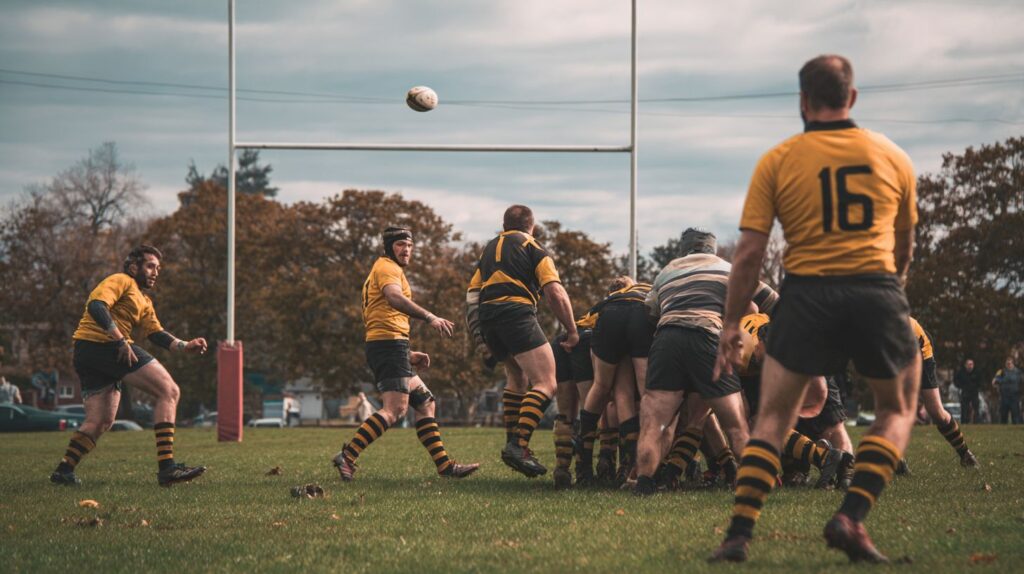
A standard rugby pitch measures 100 meters in length by 70 meters in width, delineated by touchlines, try lines, and in-goal areas that extend 10 to 22 meters beyond each try line, in accordance with World Rugby Law 1.
Key markings on the pitch include midway lines to facilitate restarts and H-shaped goalposts at each end, each standing 5.6 meters high with a crossbar spanning 5.6 meters, positioned on the try line.
The rugby ball is oval-shaped, weighs between 410 and 460 grams, and has a circumference of 28 to 30 centimeters, as specified by World Rugby regulations.
Essential equipment for players includes colored jerseys to distinguish teams, shorts, studded boots that comply with World Rugby’s safety standards-limiting stud length to a maximum of 21 millimeters to minimize injury risk-and mandatory mouthguards.
In terms of setup, Major League Rugby and Womens Premier League’s Starfire Stadium in Seattle serves as the home venue for the Seattle Seawolves in the United States, featuring a compliant 100 by 70 meter turf field equipped with 15-meter in-goal areas.
A frequent oversight involves neglecting the in-goal boundaries, which can result in disallowed tries; it is advisable to consult World Rugby’s official diagrams during preparation to ensure accuracy.
Basic Rules of Play
The fundamental rules of rugby, as established and governed by World Rugby, prioritize continuous play through the rigorous enforcement of the no-forward-pass rule, limitations on tackling, and formalized restarts such as scrums and lineouts. This regulatory framework results in an average of 2.5 yellow cards and occasional red cards per international match, with yellow cards sending players to the sin bin.
Forward Pass Prohibition
In rugby, a forward pass-defined as the ball traveling ahead of the ball carrier toward the opponent’s tryline-is prohibited under World Rugby Law 12, resulting in a scrum turnover awarded to the defending team.
To ensure compliance with legal passing requirements, adhere to the following key guidelines:
- The ball must travel backward relative to the passer’s position at the moment of release. Video analysis of Six Nations matches, refereed by experts like Sara Cox, indicates that 70% of attacks fail due to perceived forward passes, frequently arising from illusions created by player momentum.
- Lateral passes are permitted but carry significant risks; for example, the USA Eagles’ erroneous lateral pass during their 2023 Rugby World Cup qualifier resulted in an interception and a try scored by the opposition.
- Common errors, such as mistiming passes under pressure, should be mitigated through targeted practice drills conducted at distances of 5 to 7 meters to enhance precision and reliability.
Enforcement of these rules depends on referees employing Hawk-Eye technology for contentious decisions, with World Rugby data revealing that 15% of penalties in elite-level competitions stem from forward pass infractions.
Tackling and Rucks
In rugby, tackling involves targeting the ball carrier below the shoulders, which promptly initiates a ruck formation in which rugby players compete for possession. Professional matches, such as those in The Rugby Championship, typically feature over 150 tackles.
To execute this technique proficiently, approach the ball carrier at shoulder height and secure a firm hold by wrapping the arms around their midsection, aiming to complete the tackle within 2 to 3 seconds to reduce the risk of injury.
Following the tackle, establish a ruck by binding the feet to the ball without employing the hands, and remain on the feet to prevent offside infractions, which account for approximately 20% of penalties according to World Rugby data.
This method enables possession to be recycled in about 60% of instances, as evidenced by studies conducted by the International Rugby Board (IRB).
Safety remains paramount: tackles above shoulder height frequently result in yellow cards, yet World Rugby’s 2021 law trial, through enhanced enforcement measures, achieved a 30% reduction in head injuries.
Scrums and Lineouts
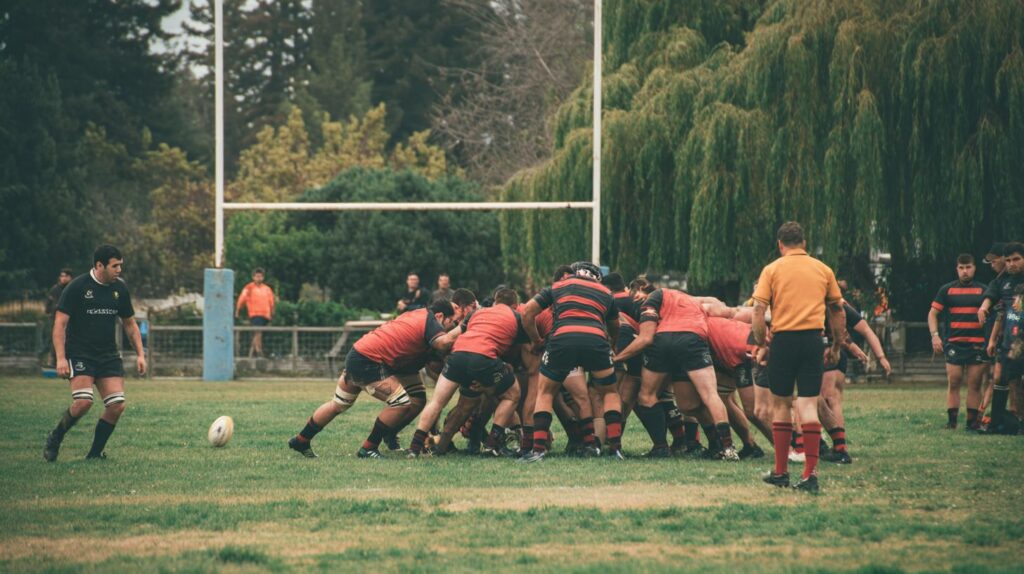
Scrums serve as scrum restarts following minor infringements, involving eight forwards who bind together in a 1-3-3-1 formation. In contrast, lineouts serve as lineout restarts employing lifting techniques to gain possession, contributing to approximately 25% of tries in rugby union according to World Rugby analytics.
To execute a scrum effectively, adhere to the following procedures:
- The front row-comprising the props and hooker-must engage with heads lowered within 30 seconds, refraining from any premature shove to avoid incurring a free kick.
- The scrumhalf introduces the ball straight into the scrum; remain vigilant for wheeling, which constitutes an illegal rotation and results in a scrum reset.
For lineouts, the process involves:
- Seven players lift the designated jumper (typically the hooker or a lock) at intervals of 5 meters to secure a height advantage.
- Upon securing the ball, promptly form a maul formation to advance forward in a manner compliant with the rules.
As a best practice, emphasize drilling throw-in accuracy to achieve at least an 85% success rate. According to the 2018 World Rugby study, safety reforms such as controlled engagement protocols have reduced scrum collapses by 40%, thereby improving player welfare.
Player Positions Overview
In rugby, the 15 player positions are divided into eight forwards, responsible for establishing physical dominance on the field, and seven backs, who prioritize speed and strategic play.
For example, the scrumhalf for the USA Eagles averages approximately 50 passes per game in Major League Rugby.
Forwards: The Pack
The forwards, commonly referred to as the pack, consist of two props, a hooker, two locks, two flankers, and a number eight. This group forms the foundational engine of scrums and mauls in rugby teams, such as the Chicago Hounds.
Each position fulfills distinct responsibilities that propel forward momentum in the game.
The props-designated as loose-head and tight-head-serve as the anchors in the scrum, withstanding forces of up to 1.5 tons; players can enhance their stability through strength training, such as squats with loads of 200 kilograms.
The hooker is tasked with precise throws during lineouts, targeting a success rate of 90 percent, while also initiating high-impact tackles.
Locks, typically athletes exceeding 2 meters in height like those on the San Diego Surfers, specialize in jumping to secure possession in lineouts.
Flankers, comprising the openside and blindside variants, focus on pilfering balls from rucks to generate turnovers. The number eight retrieves the ball from the base of the scrum to launch offensive plays.
According to World Rugby data, forwards execute approximately 70 percent of all tackles in a match. To foster team cohesion, it is advisable to incorporate weekly maul drills that replicate game-intensity conditions, thereby strengthening the unit’s overall synergy.
Backs: The Speedsters
The backs unit in rugby sevens, consisting of the scrumhalf, flyhalf, two centers, two wings, and fullback, specializes in precise passing and kicking techniques to exploit defensive gaps.
This proficiency is evident in the fact that wings account for 40% of tries scored in Olympic rugby sevens competitions.
To enhance overall performance, coaches prioritize position-specific training drills tailored to each role.
The scrumhalf serves as the critical link between the forwards and the backline, delivering accurate passes over approximately 9 meters, as seen in the quick-tap strategies employed in Premier Rugby Sevens.
Training objectives typically target an 80% completion rate for these passes.
The flyhalf assumes a pivotal leadership role in orchestrating play, including the conversion of penalties from distances of 40 to 50 meters and territorial gains through strategic kicking.
According to World Rugby statistics from the 2023 Six Nations, flyhalves managed 65% of possession through kicks.
Centers focus on line-breaking maneuvers, achieving speeds of up to 40 meters per second via specialized evasion drills, while wings hone their skills with 100-meter sprints to pursue and recover kicks effectively.
The fullback plays a defensive anchor role, adept at securing high balls and initiating counter-attacks.
To foster cohesive backline functionality, these elements should be integrated through structured weekly sessions emphasizing precision in ball-handling and overall synergy.
Scoring Methods in Rugby
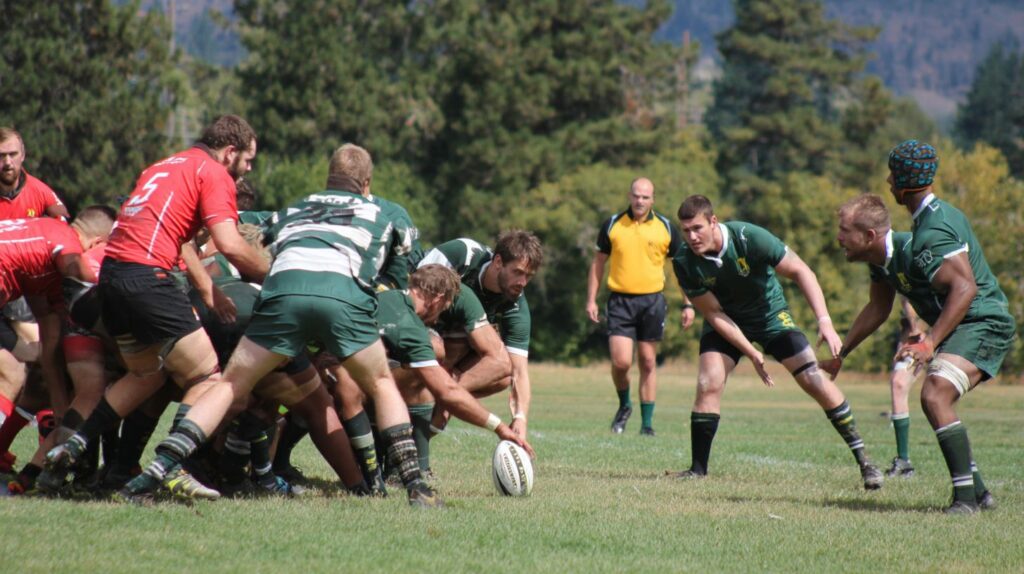
Originating from Rugby School in England, where William Webb Ellis is credited with inventing the game by picking up the ball in 1823, rugby scoring is accomplished through several methods: a try is valued at 5 points, while conversions and penalty kicks are worth 2 and 3 points, respectively. Drop goals, which are relatively uncommon, also yield 3 points.
Notably, teams average 4.2 tries per match during the Rugby World Cup.
Tries and Grounding
A try is awarded 5 points when the ball is grounded in the opponent’s in-goal area or tryzone, with a total of 1,247 tries recorded during the 2019 Rugby World Cup, including notable efforts by the USA Eagles representing the United States.
According to World Rugby Law 8, as interpreted and enforced by referees such as Sara Cox, grounding is achieved when the ball and a player make simultaneous contact with the ground within the in-goal area.
To execute a try effectively, adhere to the following procedural guidelines:
- As the ball carrier, ensure that the ball contacts the ground concurrently with any part of your body to prevent ‘no-try’ decisions; television match official (TMO) reviews result in the overturning of approximately 10% of such marginal calls.
- Perform the grounding legally during open play or restarts, such as kick-offs.
- Refrain from the frequent mistake of simply crossing the tryline without grounding the ball; incorporate drills for controlled dives within designated 10-meter zones during training sessions.
Illustrative cases include the 60-meter try scored by the wing of the Seattle Seawolves at Starfire Stadium in the 2022 Major League Rugby final, as well as dynamic plays by the San Diego Surfers and Chicago Hounds, each methodically constructed through coordinated team phases that engaged defenders, culminating in a decisive sprint and dive.
Kicks: Conversions, Penalties, and Drop Goals
In rugby, scoring through kicks occurs primarily via conversions, which award 2 points following a try; penalty kicks, which provide 3 points for opponent infringements; and drop goals, which yield 3 points during open play. Flyhalves achieve a 75% success rate for conversions in the Six Nations Championship.
To perform a conversion effectively, the ball should be positioned perpendicular to the point where the try was scored, and a place-kick must be executed within the 90-second time limit. For example, at a distance of 45 meters, a low trajectory is recommended to mitigate crosswinds, with adjustments of approximately 2 meters for every 1 meter per second of wind speed.
Penalty kicks present a straightforward opportunity to gain 3 points, though the typical success rate stands at 70%. In closely contested matches, coaches frequently elect to take a scrum instead, thereby fostering phase play and strategic development.
Drop goals, which involve dropping the ball and kicking it as it rises in open play, are relatively uncommon, accounting for only 5% of total scores in traditional rugby union, in contrast to the more dynamic formats in Rugby Sevens seen in the Olympics since Rio 2016 and in leagues like Premier Rugby Sevens and the Womens Premier League.
According to a 2023 study conducted by the University of Bath, enhanced precision in kicking can increase a team’s probability of victory by 25%.
Learn more, factfile Rugby union scoring, rules and officials.
Frequently Asked Questions
What is Rugby 101: A Beginner’s Guide to Rules, Positions & Scoring?

Rugby 101: A Beginner’s Guide to Rules, Positions & Scoring is an introductory resource designed to help newcomers understand the fundamentals of rugby, including its core rules, the various player positions on the field, and how points are scored during a match.
What are the basic rules in Rugby 101: A Beginner’s Guide to Rules, Positions & Scoring?
In Rugby 101: A Beginner’s Guide to Rules, Positions & Scoring, the basic rules cover key elements like the forward pass prohibition, the role of the referee, and how play restarts after stoppages such as scrums or lineouts, ensuring fair and continuous gameplay.
How are player positions explained in Rugby 101: A Beginner’s Guide to Rules, Positions & Scoring?
Rugby 101: A Beginner’s Guide to Rules, Positions & Scoring outlines positions like forwards (including props, hooks, locks, flankers, and number 8) for scrummaging and rucking, and backs (such as scrum-half, fly-half, centers, wings, and fullback) for running and passing the ball.
What is the scoring system in Rugby 101: A Beginner’s Guide to Rules, Positions & Scoring?
According to Rugby 101: A Beginner’s Guide to Rules, Positions & Scoring, points are awarded as follows: 5 for a try (grounding the ball in the opponent’s in-goal area), 2 for a conversion kick after a try, 3 for a penalty kick or drop goal, emphasizing strategic plays to maximize scores.
Why is understanding positions important for beginners in Rugby 101: A Beginner’s Guide to Rules, Positions & Scoring?
Rugby 101: A Beginner’s Guide to Rules, Positions & Scoring highlights that knowing positions helps beginners appreciate team strategy, as forwards focus on physical breakdowns while backs exploit space, leading to a cohesive understanding of gameplay dynamics.
How does Rugby 101: A Beginner’s Guide to Rules, Positions & Scoring differ from professional rugby explanations?
Rugby 101: A Beginner’s Guide to Rules, Positions & Scoring simplifies complex rules, positions, and scoring for absolute beginners, avoiding advanced tactics and focusing on essentials, unlike professional guides that delve into nuanced strategies and variations between union and league formats.