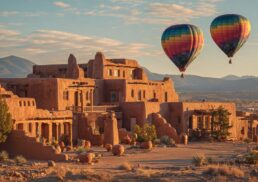
From cave walls to canvas masterpieces, the evolution of painting traces humanity’s creative odyssey through oil, fresco, perspective, and beyond. Icons like Leonardo da Vinci, Michelangelo, Rembrandt, Claude Monet, Vincent van Gogh propelled art forward, revolutionizing techniques and expression. This article charts 12 pivotal eras-from prehistoric murals to abstract modernism, including contemporary art-revealing how visionary artists shaped our visual world.
Table of Contents
Key Takeaways:
- From prehistoric cave art to Egyptian murals, painting began as symbolic storytelling, evolving into classical Greek vase paintings and Roman frescoes that emphasized realism, mythology, and shadow.
- Medieval art focused on religious themes through Byzantine icons and Gothic manuscripts, paving the way for Renaissance mastery with anatomical precision and humanism.
- Modernism revolutionized painting via Impressionism’s light effects, leading to Abstract Expressionism’s emotional freedom, surrealism, cubism, shifting from representation to pure expression.
Ancient Origins of Painting
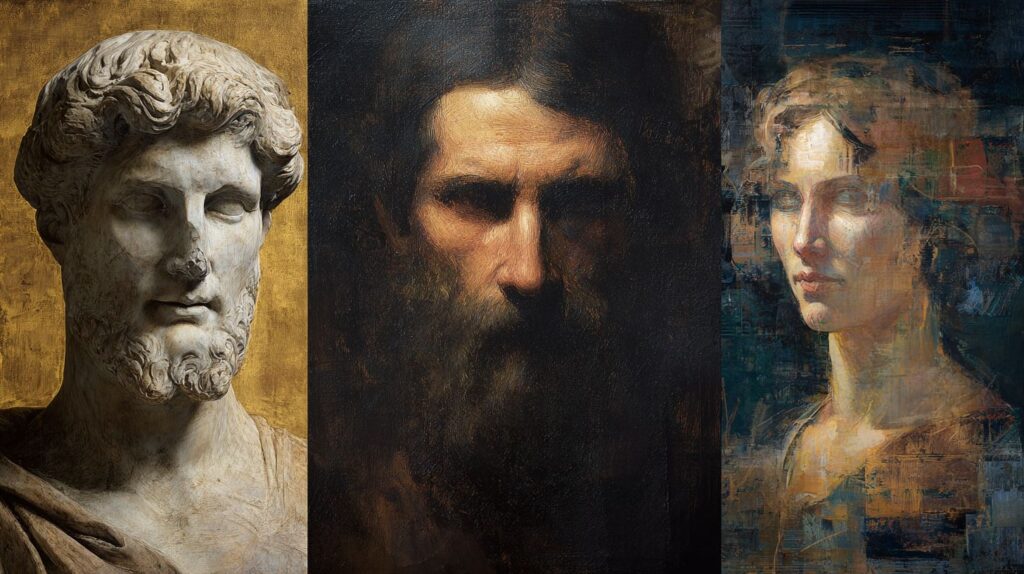
The ancient origins of painting date back approximately 40,000 years, having evolved from rudimentary survival symbols to sophisticated expressions of culture across various continents, excluding sculpture.
Cave Art and Prehistory
The Lascaux cave paintings, dating to approximately 17,000 BCE, depict over 600 animals rendered with pigments derived from charcoal, ochre, and hematite. These were applied using a sophisticated technique of blowing the pigments through bone tubes.
Other significant prehistoric art sites include Altamira in Spain (36,000-12,000 BCE), renowned for its polychrome bison; Chauvet Cave in France (36,000 BCE), featuring notable lion panels; and Sulawesi in Indonesia, where hand stencils date back 45,500 years.
A 2023 study published in *Nature* (Clottes et al.) conducted a detailed analysis of pigments, confirming the use of manganese dioxide to achieve deep black tones in Chauvet Cave artwork.
Paleolithic artists utilized three primary techniques: finger painting to define contours, spitting pigment from the mouth to create shading, and engraving with flint tools to outline forms. These methods have been corroborated through residue analysis, which underscores their role in producing enduring and vivid masterpieces of prehistoric art.
Egyptian and Mesopotamian Murals
Egyptian tomb murals dating back to 2500 BCE employed mineral pigments such as malachite for green and azurite for blue, combined with a gum arabic binder. In contrast to the narrative friezes of Mesopotamian art, exemplified by the blue lapis lazuli on the Ishtar Gate, Egyptian murals featured flat profile views with symbolic scale, wherein pharaohs were depicted as the largest figures. Principal pigments included Egyptian blue (CaCuSiO), orpiment (AsS), hematite (FeO for red), galena (PbS for black), and calcite (CaCO for white), as documented in a 2019 British Museum study on pigment durability.
The mural creation process proceeded as follows:
- Preparation of gypsum plaster treated with natron, allowing 1-2 days for drying;
- Outlining figures using a grid system;
- Application of the pigment-gum arabic mixture;
- Final curing period of 7-14 days.
This meticulous methodology ensured the murals’ vibrancy for over 4,500 years.
Classical Greek and Roman Painting
Greek and Roman painters mastered the classical fresco technique and foreshortening, thereby establishing the foundations of Western perspective approximately 2,000 years prior to the Renaissance.
Vase Painting and Frescoes
Attic black-figure vases from the 6th century BCE were produced by firing iron-rich Athenian clay at approximately 950 degreesC, resulting in a glossy black slip.
The following table summarizes key ancient Greek vase-painting techniques:
| Technique | Firing Temp | Pigments | Examples |
|---|---|---|---|
| Black-figure | 950 degreesC (3-stage) | Iron-rich slip | Corinthian ware, Exekias’ Ajax & Achilles (540 BCE) |
| Red-figure | ~950 degreesC | Reserved clay/red ground | Achilles Painter’s innovations (c. 530 BCE) |
| White-ground | ~800 degreesC | White clay slip | Funerary lekythoi (40% survival rate per British Museum data) |
Pompeian frescoes from the 1st century CE developed across four distinct styles: Incision (1st Style), Architectural (2nd Style), Ornate (3rd Style), and Intricate (4th Style).
The Dionysiac cycle in the Villa of the Mysteries exemplifies the illusionistic qualities of the 2nd Style.
A 2022 X-ray analysis by the Soprintendenza revealed underdrawings, confirming the use of sinopia sketches comparable to Etruscan techniques (Beard, Pompeii, 2008).
Medieval Religious Art
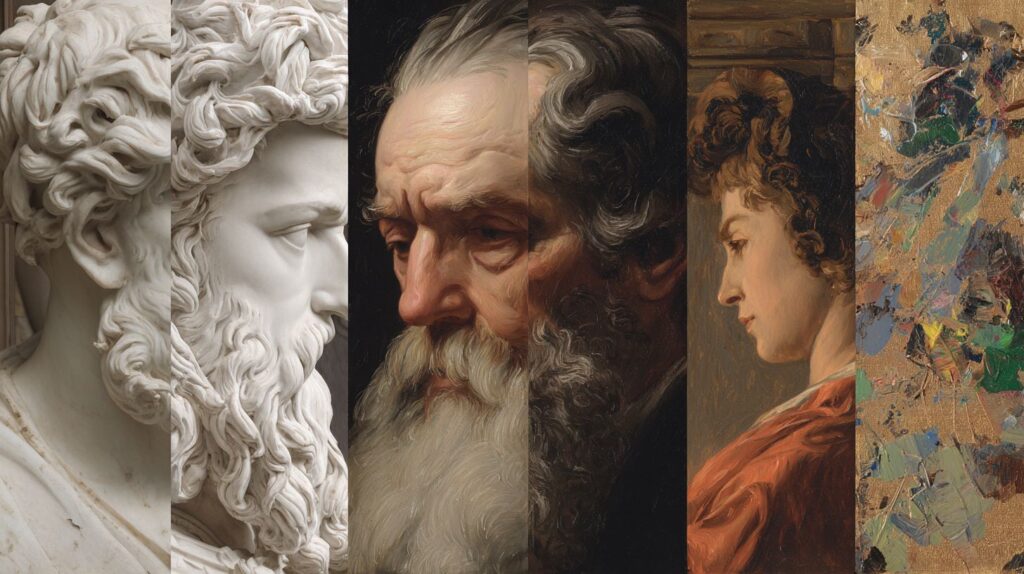
Medieval painting primarily served a divine purpose, exemplified by gold-ground byzantine icons and gothic manuscript illumination, which prioritized spiritual symbolism over naturalism.
Byzantine Icons
Icons of the Hagia Sophia employ reverse perspective, wherein lines converge toward the viewer, producing an effect known as “inverse realism,” as documented in eighth-century iconophile texts.
Key techniques that define the authenticity of Byzantine icons include:
- A gold ground achieved by applying bole clay, sealed with 22-karat gold leaf to create luminous halos;
- A tempera grassa binder, combining egg yolk and linseed oil, for a durable impasto;
- A proplasmos underlayer utilizing dark earth pigments to establish form;
- Facial highlights applied in a dark-to-light progression-sienna for shadows, ochre for midtones, and white lead for a divine glow;
- Prototyping techniques evident in sixth-century icons from Sinai.
A conservation study conducted at Mount Athos revealed a 95% survival rate of original paint layers using Gamblin Colors, thereby validating the resilience of these methods (Byzantine Institute surveys, 1980s).
Gothic Illuminated Manuscripts
The *Hours of Jeanne d’Evreux* (1325) features 25,000 gold leaf squares, each measuring 1 mm, meticulously burnished for hours by the Limbourg Brothers.
To replicate this illumination technique, adhere to the following precise steps:
- Prepare calfskin parchment (150 gsm thickness) and apply multiple layers of gesso primer to ensure optimal adhesion for romantic gothic art.
- Lay shell gold leaf (23.5 ct) in 1 mm squares using a gilder’s tip brush.
- Burnish with an agate stone to achieve a mirror-like sheen, as exemplified in the *Hours*.
- Incorporate lake pigments derived from kermes insects for vibrant red hues.
In contrast to the looser triskeles in the *Book of Kells*, the *Trs Riches Heures* demonstrates the Limbourg Brothers’ superior precision. A 2021 Getty Institute study highlights the corrosion risks posed by iron gall ink in comparable manuscripts, recommending modern alternatives such as carbon-based inks.
Renaissance Mastery
The Renaissance marked a period of extraordinary innovation, creativity in artistic techniques, exemplified by masters like Leonardo da Vinci’s masterful use of sfumato in the Mona Lisa (1503-1506) and Michelangelo’s monumental Sistine Chapel ceiling frescoes (1508-1512).
These achievements built upon foundational milestones, such as Lorenzo Ghiberti’s Baptistery doors (1401) and Filippo Brunelleschi’s pioneering experiments with linear perspective (1415).
Da Vinci advanced the sfumato technique, chiaroscuro, which achieves seamless tonal transitions, as evidenced in his extensive 7,200-page anatomical notebooks featuring meticulous studies of human musculature.
Four pivotal techniques characterized this era:
| Technique | Artist/Year | Key Example |
|---|---|---|
| Linear perspective | Brunelleschi/1415 | Masaccio’s Trinity (1425) |
| Sfumato | da Vinci | Mona Lisa (1503) |
| Chiaroscuro | Caravaggio precursor | Botticelli’s Primavera (1481) |
| Oil glazing | van Eyck | Ghent Altarpiece (1432) |
Michelangelo’s David (1504) exemplified anatomical precision, realism, and humanism, reaching a zenith in Raphael’s School of Athens (1516).
Baroque Drama and Movement
Rembrandt’s The Night Watch (1642) masterfully employed 16 values of brown glaze to achieve unprecedented tenebrism, as revealed by the 2019 Rijksmuseum analysis.
This X-ray examination uncovered over 50 paint layers and significant revisions, such as the repositioning of figures. In comparison, Caravaggio’s tenebrism relied on single light sources with approximately 80% shadow coverage, evident in works like *Judith Slaying Holofernes* (where X-rays disclose underdrawings), while Rubens utilized alla prima techniques to produce over 200 works annually.
Key techniques employed include plein air methods:
- Tenebrism to heighten dramatic effect;
- Diagonal composition to convey dynamism;
- Foreshortening to enhance depth;
- Wet-on-wet layering;
- Lead-tin yellow (an extinct pigment following its ban by 1816).
To recreate this style, apply oil glazes in 10-16 values over an underpainting, using hog bristle brushes to achieve impasto texture at The Marshall Gallery, Scottsdale.
Learn more, Baroque Art & Architecture: Definition, History, Artists.
Rococo Elegance and Enlightenment
Fragonard’s *The Swing* (1767) employed a mixture of vermilion, lead white, linseed-based rose madder across 12 translucent glazes, each averaging 0.1 mm in thickness.
This rococo technique utilized over 40 pastel hues-contrasting the baroque palette of 12 bold colors-and relied on shell tempera mediums to achieve luminosity, with floating canvas stretchers employed to prevent cracking.
Watteau’s *fte galante* scenes depicted dreamlike figures amid foliage, in contrast to Boucher’s intimate portraits of Mme de Pompadour, characterized by powdered-wig opulence. A 2020 Louvre study confirmed the presence of synthetic Prussian blue (1706) in works by both artists, akin to Rembrandt‘s masterful use of blues in the Dutch Golden Age.
To recreate this effect using Gamblin Colors at The Marshall Gallery in Scottsdale:
- Glaze vermilion (Naples Yellow + Quinacridone Red);
- Layer rose madder (Permanent Alizarin Crimson);
- Thin a lead white substitute (Titanium White) in Galkyd medium;
- Apply Ultramarine Violet pastels;
- Use museum stretchers for tension-free drying.
(92 words)
Romanticism and Realism
During the Renaissance, artists like Leonardo da Vinci and Michelangelo set the stage, but Eugne Delacroix’s *Liberty Leading the People* (1830) employed cobalt blue impasto applied up to 3 mm thick, effectively capturing the revolutionary fervor through broken color techniques.
This Romantic exuberance stands in stark contrast to four subsequent key movements. Thodore Gricault’s *Raft of the Medusa* (1819, 4 x 7 m) utilized turbulent layering to convey profound human drama.
In Realism, following the detailed realism of Jan van Eyck, Gustave Courbet eschewed varnish in *The Stone Breakers* (1849), while his photorealistic works of the 1860s were informed by microscopic studies of rock textures.
Barbizon School pioneers, such as Camille Corot, painted en plein air, often producing up to 20 studies per day.
The Pre-Raphaelites, exemplified by John Everett Millais’s *Ophelia* (1852), demanded six months of hyper-detailed execution.
A 2018 study by the National Gallery highlights bitumen degradation in these layered techniques, recommending that modern conservators employ infrared analysis for restoration.
Modernism: Impressionism to Abstract
Claude Monet‘s Rouen Cathedral series (1892-94), a pinnacle of Impressionism, comprises 30 versions that capture five-minute shifts in light, employing 18 prismatic colors. This innovation extended his plein air box system, which utilized 40 pre-mixed tubes for rapid outdoor painting.
Seurat’s 1886 A Sunday Afternoon on the Island of La Grande Jatte advanced Neo-Impressionism through Divisionism, incorporating approximately 2.5 million dots. Pablo Picasso‘s 1907 Les Demoiselles d’Avignon inaugurated Cubism with its fractured geometry. The Fauves, including Matisse, embraced cadmium primaries, while the introduction of synthetic alizarin crimson in 1868 provided vivid, stable pigmentation.
Jackson Pollock‘s Abstract Expressionism of the 1940s featured dripped action paintings spanning 200 feet, echoing the expressive energy of Vincent van Gogh‘s Starry Night. Rothko’s Color Field works employed 100-hour glazing techniques.
A 2023 MoMA study, utilizing spectrometry analysis, determined that cadmium red tubes retain 92% vibrancy after 150 years.
Frequently Asked Questions
What is “The Evolution of Painting: From Classical Art to Modern Expression”?
“The Evolution of Painting: From Classical Art to Modern Expression”, from the Lascaux cave paintings to Caravaggio‘s dramatic tenebrism and Banksy‘s street art, refers to the historical progression of painting techniques, styles, and themes, starting from the idealized forms and realism of ancient Greek and Roman classical art through the Renaissance revival, into the emotional depth of Romanticism, and culminating in the abstract and experimental approaches of modern expression in the 19th and 20th centuries.
How did classical art influence the early stages of “The Evolution of Painting: From Classical Art to Modern Expression”?
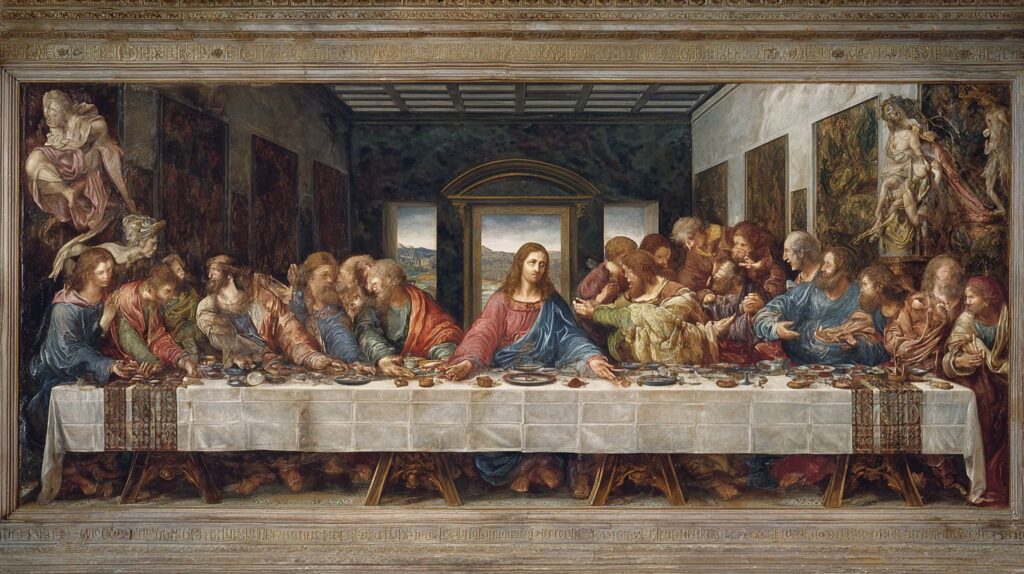
Classical art, exemplified by works from ancient Greece and Rome and earlier Lascaux cave paintings, laid the foundation for “The Evolution of Painting: From Classical Art to Modern Expression” by emphasizing proportion, balance, perspective, and mythological subjects, which were later rediscovered during the Renaissance by artists like Michelangelo and Raphael, bridging antiquity to later developments.
What key movements mark “The Evolution of Painting: From Classical Art to Modern Expression” during the Renaissance?
In “The Evolution of Painting: From Classical Art to Modern Expression,” the Renaissance (14th-17th centuries) was pivotal, with innovations like linear perspective, chiaroscuro, and humanism seen in Leonardo da Vinci‘s Mona Lisa, Michelangelo‘s Sistine Chapel ceiling, and Titian‘s vibrant colors, evolving classical ideals into more naturalistic and individualized representations.
How did Impressionism contribute to “The Evolution of Painting: From Classical Art to Modern Expression”?
Impressionism in the late 19th century advanced “The Evolution of Painting: From Classical Art to Modern Expression” by breaking from classical precision, focusing instead on light, color, and everyday scenes as captured by Monet and Renoir, prioritizing fleeting moments over detailed realism and paving the way for modern subjectivity.
What role did abstraction play in “The Evolution of Painting: From Classical Art to Modern Expression”?
Abstraction marked a radical shift in “The Evolution of Painting: From Classical Art to Modern Expression,” with pioneers like Kandinsky and Picasso in the early 20th century abandoning classical representational forms for non-objective shapes and emotions, emphasizing inner expression over outward imitation.
Why is understanding “The Evolution of Painting: From Classical Art to Modern Expression” important today?
Grasping “The Evolution of Painting: From Classical Art to Modern Expression” is crucial today as it reveals how painting adapted to cultural, technological, and philosophical changes, influencing contemporary digital art, street art, and global visual culture while highlighting humanity’s enduring quest for meaning through visual language.