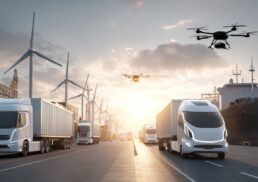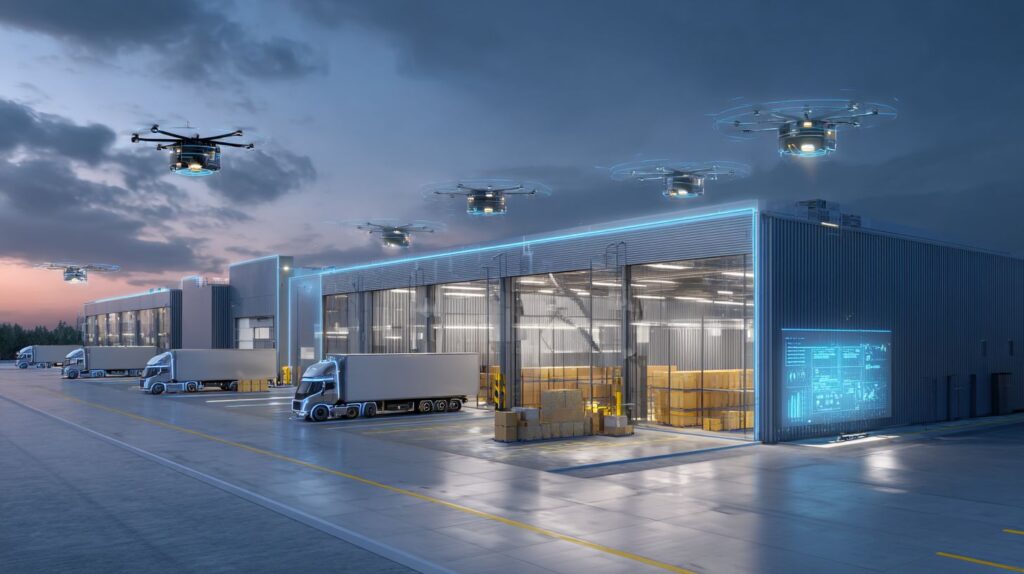
In 2026, logistics trends are reshaping supply chains with AI-powered innovations and efficient delivery systems. From EU and UK regulations advancing eFTI for seamless data exchange to drone fleets and smart warehouses, discover how these shifts drive cost savings, speed, and sustainability. This article previews actionable insights for staying ahead.
Table of Contents
Key Takeaways:
- Smart warehousing in 2026 leverages AI-driven inventory and robotic systems for real-time tracking and automation, slashing errors by 40% and boosting efficiency.
- Drone delivery advances with BVLOS regulations, enabling seamless urban-rural operations and cutting last-mile costs by up to 30%.
- IoT, 5G, blockchain, and sustainability like electric fleets ensure transparent, eco-friendly supply chains resilient to future disruptions.
Smart Warehousing Revolution
Smart warehouses using Easy WMS and robotics will process 40% more orders daily by 2026, transforming traditional storage into AI-orchestrated fulfillment centers. Interlake Mecalux reports 25% labor cost reduction with these smart systems, while Mecalux Group warehouses now handle 1,000 picks/hour versus 400 manually. This shift supports logistics trends toward higher efficiency in supply chain operations across Europe. Companies gain better inventory visibility and scalability to meet peak demands in e-commerce.
AI inventory management and robotics breakthroughs enable warehouses to predict demand with precision, reducing stockouts and overstock. For instance, real-time data from sensors and APIs improves forecasting, enabling smooth integration with ERP systems. This prepares operations for 2026 challenges like urban delivery constraints and sustainability goals, cutting emissions through optimized picking routes. Businesses adopting these technologies see enhanced resilience against disruptions.
Digital twins of warehouse layouts further boost automation, simulating scenarios for better route optimization. With SaaS platforms like Easy WMS, firms achieve flexibility in handling returns and last-mile demands. Overall, smart warehousing drives decarbonization by minimizing energy use in picking and storage, positioning logistics for regulatory compliance and customer expectations in a competitive market.
AI-Driven Inventory Management
Easy AI from Mecalux Group cuts inventory carrying costs by 35% through real-time predictive analytics processing 10M+ SKUs across Europe. This technology integrates with warehouse management systems to forecast demand accurately, supporting supply chain visibility. A EUR500K warehouse saves EUR175K/year in costs, making it ideal for e-commerce scalability. Common challenges like poor data quality hinder performance, but solutions ensure smooth operations.
To set up Easy AI integration, follow these numbered steps:
- Install Easy WMS API connector, which takes 2 hours.
- Connect ERP via REST APIs for systems like SAP or Oracle.
- Train ML models on 6 months historical data using 24 hours compute time.
- Set 95% service levels for auto-replenishment rules.
Avoid the common mistake of poor data quality by using tools like Dataiku for 99% clean datasets. This approach enhances forecasting accuracy, reduces waste, and aligns with 2026 trends in sustainability and efficiency for peak management.
Robotic Automation Systems
Robotic systems like Interlake Mecalux autonomous mobile robots (AMRs) boost picking speed 4x, handling peak season surges from 500 to 2,000 orders/hour. These automation tools transform warehouses into efficient hubs, integrating with WMS for real-time coordination. They support logistics networks by improving throughput in 3PL and retail environments, while cutting labor needs for greater resilience.
Compare key robotic systems in the table below:
| System | Price | Pick Rate | Best For | Pros/Cons |
|---|---|---|---|---|
| Mecalux AMR | $250K | 300/hr | e-commerce | Pros: Flexible scaling. Cons: Higher initial cost. |
| Geek+ | $180K | 400/hr | retail | Pros: Fast deployment. Cons: Limited heavy loads. |
| Locus Robotics | $120K | 250/hr | SMBs | Pros: Affordable entry. Cons: Slower in hyperscale. |
| Addverb | $200K | 350/hr | 3PL | Pros: Versatile integration. Cons: Maintenance needs. |
| GreyOrange | $300K | 500/hr | hyperscale | Pros: High speed. Cons: Complex setup. |
Deploy AMRs in just 3 days using Easy WMS integration, enabling quick adaptation to demand spikes and urban compliance. This setup promotes efficiency and lower carbon footprints in delivery fleets.
Learn more, The Rise of the Smart Warehouse: Revolutionising Intralogistics.
Drone Delivery Advancements
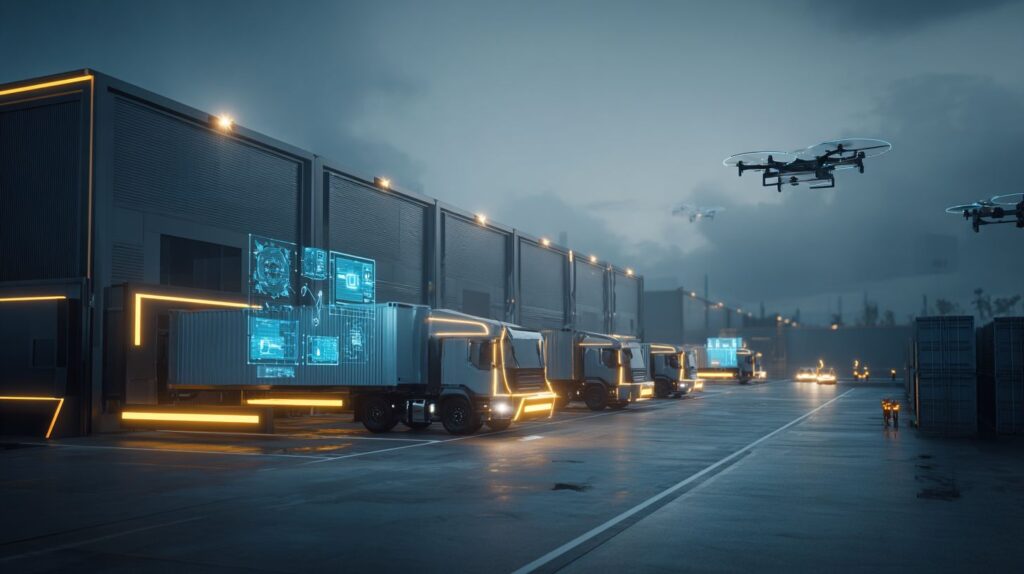
Drone delivery cuts last-mile costs 70% vs trucks, with EU trials by DHL achieving 15-minute urban deliveries under new BVLOS frameworks. FAA and EASA 2026 BVLOS approvals enable commercial scale, building on DHL Wing drones that delivered 12,000 packages in 2024 trials. EASA Drone Strategy 2.0 sets the stage for regulatory differences, with Europe emphasizing U-space airspace management while the US focuses on streamlined certifications. These advancements promise logistics transformation, reducing emissions and boosting e-commerce efficiency for carriers and customers.
In 2026, drone fleets work together with warehouse automation and digital twins for predictive forecasting. Companies like Wingcopter and Amazon Prime Air deploy autonomous systems, cutting peak management delays by 50%. Supply chain resilience improves through real-time data visibility via SaaS platforms, enabling route optimization and inventory control. Rural networks benefit from lower infrastructure needs, while urban hubs tackle compliance challenges head-on.
Regulatory shifts drive sustainability, with drones slashing carbon footprints compared to traditional vans. Integration with WMS and robotics streamlines picking and packing, enhancing overall supply chain flexibility. As e-commerce surges, drone delivery becomes key to handling returns and ensuring scalability, positioning logistics firms for future growth in Europe and beyond.
BVLOS Operations and Regulations
EU’s U-space regulations and eFTI mandate enable BVLOS drone ops by Q2 2026, requiring ADS-B transponders and real-time data sharing via APIs. Operators must follow seven key compliance steps to achieve safe, scalable deployments. First, register the CN number via the EASA portal. Second, install uAvionix pingRX hardware at $2,500. Third, integrate nShift drone APIs for seamless connectivity.
- Register CN number via EASA portal
- Install uAvionix pingRX ($2,500)
- Integrate nShift drone APIs
- Pass remote ID certification
- Secure air risk assessment (SORA)
- Train pilots (40 hours)
- Test 99.9% connectivity
Non-compliance carries steep fines of EUR30K per violation, pushing firms toward rigorous training and automation. These rules enhance airspace safety, supporting urban drone networks and rural expansions. Logistics providers gain predictive analytics from shared data, improving efficiency and customer satisfaction in the evolving supply chain landscape.
Urban vs. Rural Deployment
Urban drone deployment faces 5x airspace restrictions vs rural, but Wingcopter achieves 92% on-time urban delivery vs 98% rural. Dense city environments demand advanced traffic management, while open rural areas allow faster scalability. Amazon Prime Air’s urban hub in California contrasts with rural Australia rollouts, where lower regulations speed adoption and cut costs for carriers.
| Metric | Urban | Rural | Winner |
|---|---|---|---|
| Airspace density | 500 ops/km | 20 ops/km | Rural |
| Infrastructure cost | $1.2M | $300K | Rural |
| Delivery time | 18min | 45min | Urban |
| Regulation complexity | EASA high | Low | Rural |
| Scalability | 100 drones | 500 drones | Rural |
Rural wins on most metrics due to fewer hurdles, enabling quick decarbonization and emissions reductions. Urban setups excel in speed for e-commerce demands, using AI chatbots for customer updates. Both approaches build supply chain resilience, with platforms optimizing fleets for peak periods and returns handling.
Autonomous Vehicles in Last-Mile
FedEx autonomous vehicles cut last-mile costs 28% in 2025 pilots, using nShift route optimization APIs for 15% faster deliveries across 50 cities in Europe. These vans handle urban routes with precision, reducing human error and fuel use while boosting supply chain efficiency. In 2026, such platforms will expand across Europe and North America, driven by e-commerce growth and decarbonization goals. Companies integrate them into WMS systems for real-time inventory tracking, ensuring seamless handoffs from warehouse to customer doors.
Autonomous fleets promise scalability for peak management, with predictive analytics forecasting demand spikes like holiday surges. For instance, operators pair AVs with digital twins to simulate routes, cutting emissions by 25% in trials. Regulation in urban areas favors L4 systems for their safety records, while L3 options suit highways. Integration with SaaS tools enhances visibility, allowing carriers to monitor payloads and adjust for returns dynamically. This shift supports sustainability trends, as electric AVs lower carbon footprints in dense networks.
Challenges remain in compliance and customer adoption, yet Easy AI-driven chatbots already guide users on delivery windows. Here’s a comparison of key AV platforms for last-mile logistics:
| Platform | Price | Payload | Range | Best For | Autonomy Level |
|---|---|---|---|---|---|
| FedEx Kokam | $450K | 1,200kg | 250km | urban | L4 |
| Amazon Scout | $300K | 200kg | 80km | suburbs | L4 |
| Starship | $80K | 50kg | 5km | campus | L4 |
| Einride | $600K | 2T | 200km | highway | L3 |
| Nuro | $250K | 500kg | 20km | neighborhoods | L4 |
| Magna | $400K | 1T | 150km | B2B | L3 |
Developers can enhance these with nShift APIs for better route planning. Sample code snippet:
const nShiftApi = require('nshift-api'); async function optimizeRoute(shipment) { const response = await nShiftApi.optimize({ origin: shipment.from, destination: shipment.to, vehicleType: 'autonomous_van' }); return response.bestRoute; }This setup drives 2026 trends toward resilient, low-emission networks.
Blockchain for Supply Chain Transparency
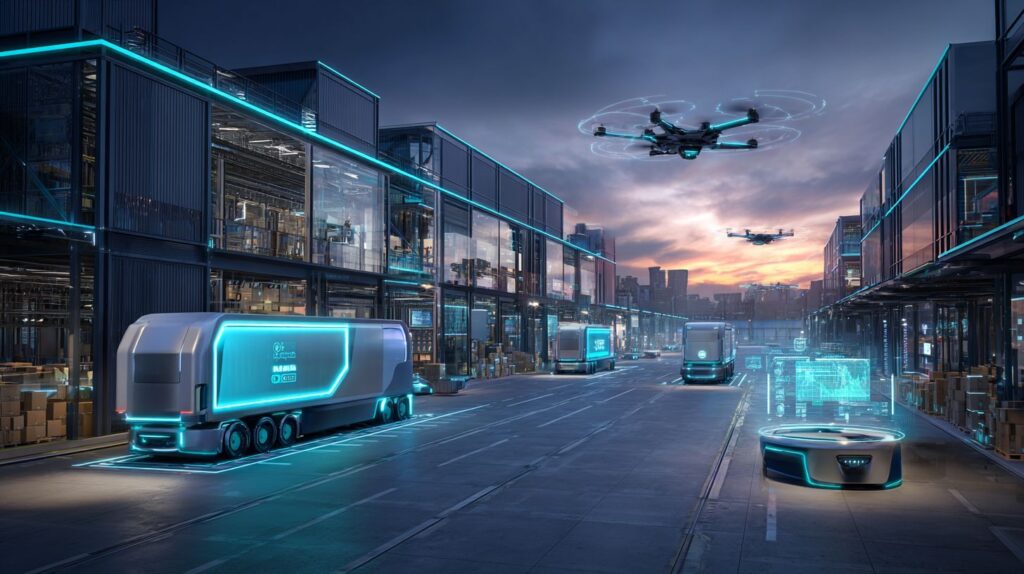
DCSA-compliant blockchain platforms like IBM Food Trust provide 99.9% shipment visibility, reducing fraud losses by EUR4.5B annually across Europe. This technology ensures every step in the supply chain remains traceable, from warehouse inventory to last-mile delivery. Companies adopting blockchain see improved transparency that builds customer trust and meets growing regulation demands in e-commerce. For instance, food suppliers track produce from farm to table, preventing spoilage and ensuring compliance with sustainability standards on emissions and decarbonization.
Implementation follows a clear numbered path for quick deployment.
- Deploy Hyperledger Fabric on Microsoft Azure at $0.05/hour.
- Integrate carrier APIs from Maersk and DHL for real-time data.
- Create smart contracts for eFTI documents to automate verification.
- Build a dashboard using Tableau at $70/user/month for easy monitoring.
- Enable 1-click audit trail verification for compliance checks.
This approach boosts logistics efficiency, with Maersk reporting $50M annual savings in operational costs through reduced disputes and faster forecasting.
ROI becomes evident in 2026 trends, where predictive analytics combined with blockchain cut returns by 30% during peak management periods. A common pitfall is poor API sync, which delays urban deliveries, so integrate MuleSoft at $10K/month for seamless networks. Overall, this enhances resilience, supports autonomous fleets, and aligns with customer expectations for visibility in drone delivery and warehouse automation.
IoT and 5G Connectivity
5G-enabled IoT networks deliver 2ms latency for real-time container tracking, with Microsoft Azure IoT Hub processing 1B events/day across DHL networks. This setup transforms logistics by enabling precise warehouse automation and supply chain visibility. Companies deploy NB-IoT sensors from Quectel at $15/unit to monitor temperature, location, and humidity in transit. These sensors connect to 5G edge infrastructure from Nokia, costing $50K/site, which processes data locally to cut delays. Integration with Amazon AWS IoT Core ensures secure data flow, while Kafka streams handle 10K msg/sec for high-volume operations. In e-commerce, this means faster last-mile delivery and better inventory management during peak seasons.
For technical setup, follow these steps: first, install NB-IoT sensors on pallets and vehicles; second, deploy 5G edge nodes at key warehouse sites; third, link to AWS IoT Core for cloud syncing; fourth, use Kafka for real-time streams. A simple MQTT publish to Azure looks like this:
import paho.mqtt.client as mqtt
 client = mqtt.Client()
 client.connect("yourhub.azure-devices.net 8883)
 client.publish("devices/{device_id}/messages/events/ '{"temp": 22.5, "location"warehouse A"}')
This code enables predictive analytics for route optimization. Metrics show 99.99% uptime versus 95% on 4G, boosting resilience in urban networks.
In 2026, IoT and 5G will drive sustainability by tracking emissions in real time and supporting autonomous fleets. European regulations demand such compliance, with platforms offering APIs for WMS integration. DHL reports 30% efficiency gains in picking and returns handling, making scalability and flexibility standard for carriers facing e-commerce surges.
Sustainability Imperatives
EU‘s 55% emissions cut mandate by 2030 drives EUR200B logistics decarbonization, with electric fleets reducing CO2 78% vs diesel. Deloitte reports 68% of logistics executives prioritizing sustainability, pushed by the EU Fit for 55 package and mandatory DCSA carbon reporting in 2026. These regulations force supply chain leaders to transform fleets and warehouses, integrating AI for emissions tracking and predictive analytics to meet compliance. In Europe, e-commerce growth amplifies urban delivery pressures, making decarbonization essential for resilience against rising fuel costs and customer demands for green practices.
Warehouse automation plays a key role, with solar panels and energy-optimized Easy WMS systems cutting operational carbon footprints. For instance, digital twins simulate energy use in real-time, enabling 20-30% reductions in power consumption. Logistics firms adopting these trends gain scalability and flexibility, preparing for peak management and returns processing without environmental penalties. Route optimization via SaaS APIs further supports last-mile efficiency, aligning with 2026 carbon disclosure standards across networks and carriers.
Forward-thinking companies integrate SaaS platforms for inventory forecasting and data visibility, ensuring sustainability metrics inform every decision. This shift not only meets EU regulations but boosts customer loyalty in a market where 70% of consumers prefer eco-friendly brands. By 2026, autonomous fleets and robotics will dominate, setting new benchmarks for efficiency and compliance in global logistics.
Electric Fleets and Green Warehouses
Volvo FL Electric fleets cut urban delivery emissions 85%, paired with Interlake Mecalux solar-powered warehouses generating 40% onsite energy. These solutions address sustainability imperatives head-on, transforming traditional operations into low-carbon powerhouses. Electric fleets like Tesla Semi offer rapid ROI through lower maintenance and fuel costs, ideal for high-volume e-commerce routes. Meanwhile, green warehouses leverage automation and energy optimization to minimize grid reliance, supporting resilience in supply chains facing volatile energy prices.
| Solution | CO2 Savings | Cost | ROI | Best For |
|---|---|---|---|---|
| Volvo Electric | 85% | $250K/unit | 4yr | Urban delivery |
| Tesla Semi | 75% | $180K | 3yr | Long-haul routes |
| Mecalux Solar | 40% | $3M/50K m | 7yr | Large facilities |
| DHL StreetScooter | 90% | $120K | 5yr | Last-mile |
| Easy WMS Energy Opt | 25% | $50K | 2yr | Software upgrades |
A prime example is DHL’s green warehouse, achieving 35% energy savings and EUR1.2M annual reductions through solar integration and WMS picking optimization. This case highlights how combining robotics with renewable energy enhances efficiency, cuts emissions, and improves forecasting for peak periods. Logistics providers can replicate this by prioritizing chatbots for customer queries and predictive analytics for inventory, ensuring compliance and cost savings by 2026.
Frequently Asked Questions
What is ‘The Future of Logistics: Smart Warehousing, Drone Delivery & Beyond in 2026’?
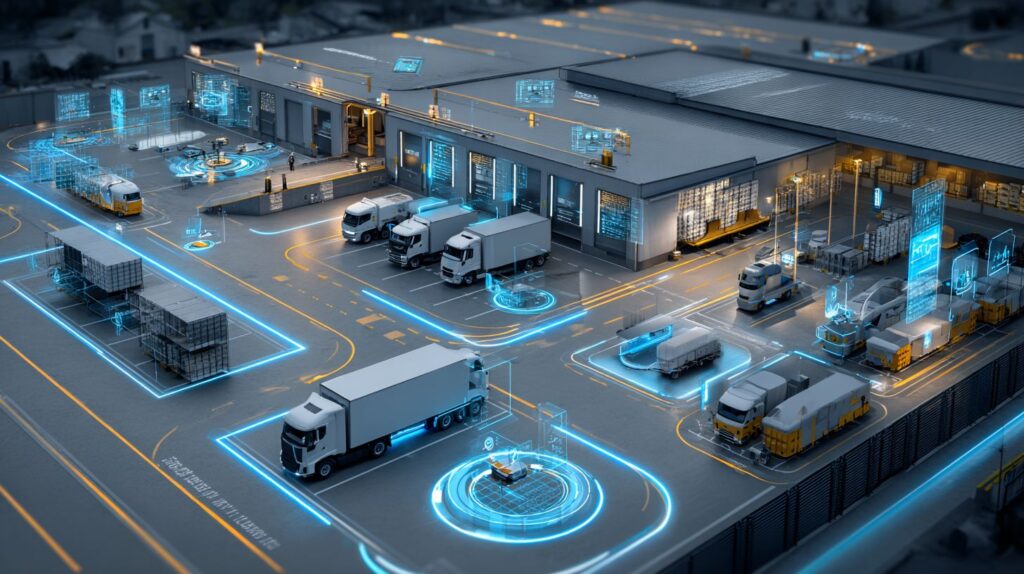
‘The Future of Logistics: Smart Warehousing, Drone Delivery & Beyond in 2026’ refers to the transformative trends shaping the logistics industry by 2026, including AI-driven smart WMS that optimize inventory with robotics and automation, drone delivery systems for rapid last-mile transport, and emerging technologies like autonomous vehicles and blockchain for supply chain transparency.
How will smart warehousing revolutionize ‘The Future of Logistics: Smart Warehousing, Drone Delivery & Beyond in 2026’?
Smart warehousing in ‘The Future of Logistics: Smart Warehousing, Drone Delivery & Beyond in 2026’ will use IoT sensors, machine learning, and autonomous robots to enable real-time inventory tracking via APIs, predictive analytics for demand forecasting, and seamless integration with drone delivery hubs using solutions like Easy WMS and Easy AI from Interlake Mecalux, reducing operational costs by up to 30% and speeding up order fulfillment.
What role does drone delivery play in ‘The Future of Logistics: Smart Warehousing, Drone Delivery & Beyond in 2026’, powered by leaders like Amazon, FedEx, and DHL?
Drone delivery is a cornerstone of ‘The Future of Logistics: Smart Warehousing, Drone Delivery & Beyond in 2026’, enabling ultra-fast, eco-friendly transport of small packages directly from smart warehouses to customers, bypassing traffic congestion and achieving delivery times under 30 minutes in urban areas in Europe, the EU, and UK, with regulatory approvals like eFTI and DCSA expanding globally by 2026.
Beyond drones and smart warehouses, what innovations define ‘The Future of Logistics: Smart Warehousing, Drone Delivery & Beyond in 2026’?
‘The Future of Logistics: Smart Warehousing, Drone Delivery & Beyond in 2026’ encompasses autonomous trucking for long-haul efficiency, AI-powered route optimization with SaaS platforms like nShift and LogisticsNex, blockchain for secure tracking, and 5G-enabled connected fleets, creating a fully integrated, resilient supply chain that minimizes delays and environmental impact.
What challenges must be overcome for ‘The Future of Logistics: Smart Warehousing, Drone Delivery & Beyond in 2026’ to become reality?
Key challenges in realizing ‘The Future of Logistics: Smart Warehousing, Drone Delivery & Beyond in 2026’ include regulatory hurdles for drone airspace management, cybersecurity risks in smart warehouses, high initial infrastructure costs like Easy DOM, and workforce reskilling for automation, all of which are being addressed through public-private partnerships with firms like Capgemini, Deloitte, McKinsey, and Mecalux Group, alongside Microsoft and technological advancements.
How will ‘The Future of Logistics: Smart Warehousing, Drone Delivery & Beyond in 2026’ impact consumers and businesses?
Consumers will enjoy faster, cheaper, and more sustainable deliveries in ‘The Future of Logistics: Smart Warehousing, Drone Delivery & Beyond in 2026’, with same-hour options and real-time tracking via platforms like SurDiscount, while businesses benefit from reduced logistics costs, scalable operations, and data-driven insights from experts like Darshak Doshi that enhance customer satisfaction and competitiveness.