The Future of Global Transportation: EVs, High-Speed Rail & Sustainable Travel In an era demanding urgent sustainability in transportation, electric vehicles (EVs) are revolutionizing mobility with zero-emission efficiency. From the rise of Electric Vehicles and expanding charging networks to groundbreaking High-Speed Rail projects and visionary Hyperloop systems, this article explores cutting-edge innovations. Discover how these advancements promise decarbonization, reduced carbon footprints and seamless travel-backed by recent IPCC reports on climate change-empowering you to navigate tomorrow’s greener world.
Table of Contents
Key Takeaways:
- Electric vehicles are revolutionizing transportation with rapid battery tech advancements and expanding charging networks, slashing emissions and reducing oil dependence through green initiatives for a carbon-neutral greener future.
- High-speed rail projects worldwide, like Europe’s TGV and Asia’s maglev lines, offer efficient, low-carbon alternatives to air travel, boosting connectivity and cutting urban congestion.
- Sustainable travel integrates EVs, rail, and multimodal systems through innovative urban planning, supported by policies that address adoption challenges and drive economic growth.
The Rise of Electric Vehicles
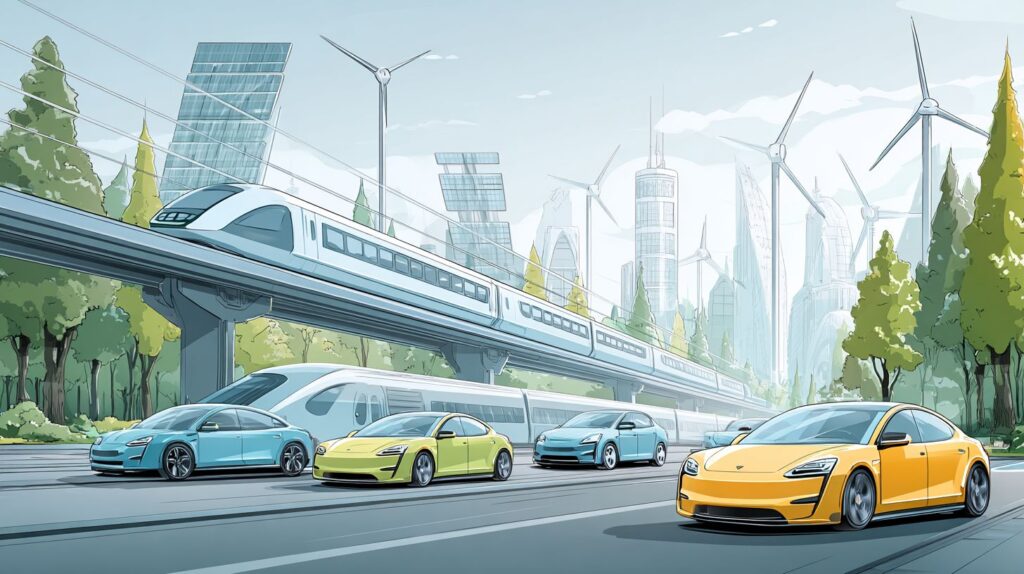
The global adoption of electric vehicles (EVs) has experienced significant growth, with sales totaling 14 million units in 2023, according to the International Energy Agency. This surge is primarily attributed to advancements in battery technology and the expansion of charging infrastructure in key markets, including the United States, China, and the European Union.
Battery Technology Advancements
Solid-state batteries, developed by innovative companies such as QuantumScape, offer a 50% increase in energy density compared to conventional lithium-ion cells. This advancement enables electric vehicles (EVs) to achieve ranges of up to 500 miles while significantly reducing charging times to less than 15 minutes.
In comparison, lithium-ion batteries generally provide ranges limited to approximately 300 miles and pose fire hazards due to their reliance on flammable liquid electrolytes. Solid-state batteries address these concerns through the use of non-flammable solid electrolytes, thereby improving safety and facilitating faster charging capabilities.
A study published in Nature Energy in 2022 demonstrates efficiency improvements of 30%, along with reduced degradation over multiple charge cycles. For EV fleet management, the implementation of predictive maintenance protocols utilizing machine learning is recommended.
The following Python code snippet, employing scikit-learn, simulates battery degradation:
from sklearn.linear_model import LinearRegression import numpy as np X = np.array(range(1, 1001)).reshape(-1, 1) y = 100 - 0.05 * X.flatten() model = LinearRegression().fit(X, y)To operationalize this approach:
- Collect historical data on battery charge cycles.
- Train the machine learning model to predict capacity loss.
- Conduct quarterly forecasts to anticipate maintenance requirements.
Charging Infrastructure Expansion
The global charging infrastructure has expanded to exceed 3 million public stations by 2023, incorporating IoT-enabled smart chargers that leverage digitalization and digital twins for real-time demand forecasting and route optimization in fleet management.
To deploy effective charging networks, adhere to the following structured steps:
- Perform a comprehensive site assessment utilizing Geographic Information System (GIS) tools, such as ArcGIS (typically requiring 2-4 weeks; prioritize high-traffic locations while mitigating urban overload to avert congestion).
- Integrate Internet of Things (IoT) capabilities with robust platforms like AWS IoT Core (at a cost of $0.08 per 1 million messages) to facilitate seamless device connectivity and continuous monitoring.
- Deploy predictive analytics through machine learning models in frameworks such as TensorFlow to equilibrate peak-hour demand and optimize energy distribution.
Common challenges encompass inadequate grid capacity; according to a PwC report, 40% of infrastructure gaps persist in the European Union, emphasizing the critical importance of government policies and early consultations with utility providers to guarantee scalability.
High-Speed Rail Developments
Global high-speed rail networks, encompassing Japan’s maglev trains and China’s extensive infrastructure, currently span over 45,000 kilometers worldwide. These systems enhance regional connectivity and freight management while reducing reliance on air travel for medium-distance routes.
Global Project Highlights
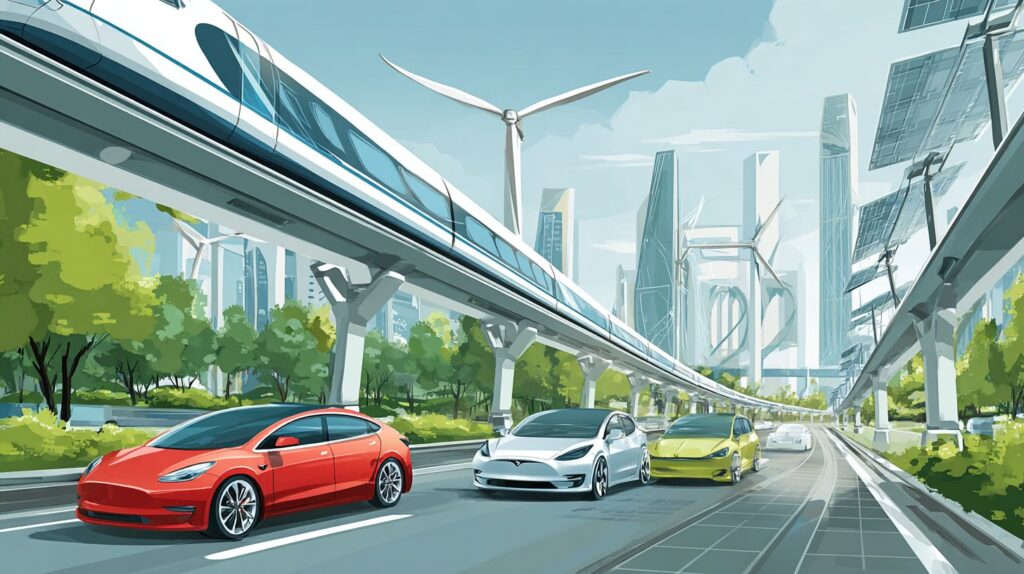
China’s Beijing-Shanghai high-speed rail line, which has been operational since 2011, accommodates approximately 200 million passengers each year while operating at speeds of up to 350 km/h. In contrast, Japan’s maglev Chuo Shinkansen project is targeted to achieve speeds of 500 km/h by 2027.
China’s extensive high-speed rail network, spanning 45,000 km, has contributed to a 10% reduction in transport emissions, as reported by the International Energy Agency (IEA). However, challenges remain in achieving interoperability with European standards under the European Rail Traffic Management System (ERTMS).
Japan’s Chuo Shinkansen initiative, with an estimated investment of $80 billion, is designed to reduce travel time between Tokyo and Nagoya from 2.5 hours by car to just 40 minutes. This system employs superconducting magnets to enhance operational efficiency.
Singapore’s forthcoming high-speed rail lines draw inspiration from the European Union’s Trans-European Transport Network (TEN-T) framework, with the objective of establishing seamless regional connectivity by 2030.
Looking toward innovative alternatives, Virgin Hyperloop’s vacuum tube prototypes reached speeds of 387 km/h during 2020 testing. According to a 2023 Gartner and SG Analytics report, such technologies are projected to yield 30% cost savings in urban transit applications.
Environmental Impact and Efficiency Benefits
High-speed rail significantly reduces carbon emissions by 90% compared to automobiles on equivalent routes. Initiatives such as Europe’s Trans-European Transport Network (TEN-T), as emphasized by Apostolos Tzitzikostas, and the adoption of Sustainable Aviation Fuel (SAF) in aviation are projected to save 52 million tons of CO2 annually by 2030.
According to the European Commission, rail transport emits only 14 grams of CO2 per passenger-kilometer, in contrast to 170 grams for air travel, positioning it as an optimal solution for long-distance journeys.
In Japan, the Shinkansen bullet train system offsets approximately 5 million tons of CO2 each year by diverting passengers from aviation routes, illustrating the potential for scalable environmental benefits.
For investors seeking ESG services, each dollar invested in high-speed rail infrastructure generates approximately four dollars in environmental savings over a 20-year period, primarily through reductions in healthcare expenditures and climate-related costs.
To attain zero emissions, the integration of biofuels and hydrogen fuel cells on designated lines is recommended, as exemplified by Germany’s forthcoming H2-powered InterCity Express (ICE) trains, which utilize water for propulsion without producing exhaust. Implementation should commence with pilot programs on underutilized routes to achieve up to 30% improvements in efficiency.
Sustainable Travel Integration
Sustainable travel integration utilizes Mobility-as-a-Service (MaaS) platforms to integrate electric vehicles (EVs), public transportation, and vertical take-off and landing (VTOL) options, thereby promoting the development of smart cities capable of reducing urban emissions by 20-30%, according to Gartner projections.
Multimodal Transport Systems
Mobility as a Service (MaaS) platforms, such as Citymapper, leverage artificial intelligence (AI) and the Internet of Things (IoT) to enable seamless integration. These platforms optimize routes across electric vehicles (EVs) and high-speed rail systems, achieving a 25% reduction in travel time in urban environments like Singapore.
Implementing comparable multimodal systems demands a methodical approach. The following numbered steps provide a structured framework:
- Aggregate data using IoT sensors, employing tools such as Azure IoT Hub for configuration (typically requiring 1-2 months and incurring costs of $500-$2,000 per month at scale). This strategy mitigates data silos and facilitates real-time traffic inputs.
- Apply AI-driven demand forecasting with solutions like Google Cloud AI, which can achieve up to 80% accuracy in predicting peak usage, as evidenced in Singapore’s pilot programs.
- Integrate user-facing applications for real-time booking through APIs, including those from Twilio for notifications.
Common challenges encompass inadequate API interoperability, which a DHL study associates with 15% efficiency reductions. Early testing of integrations is recommended to maximize operational benefits.
Urban Planning Innovations
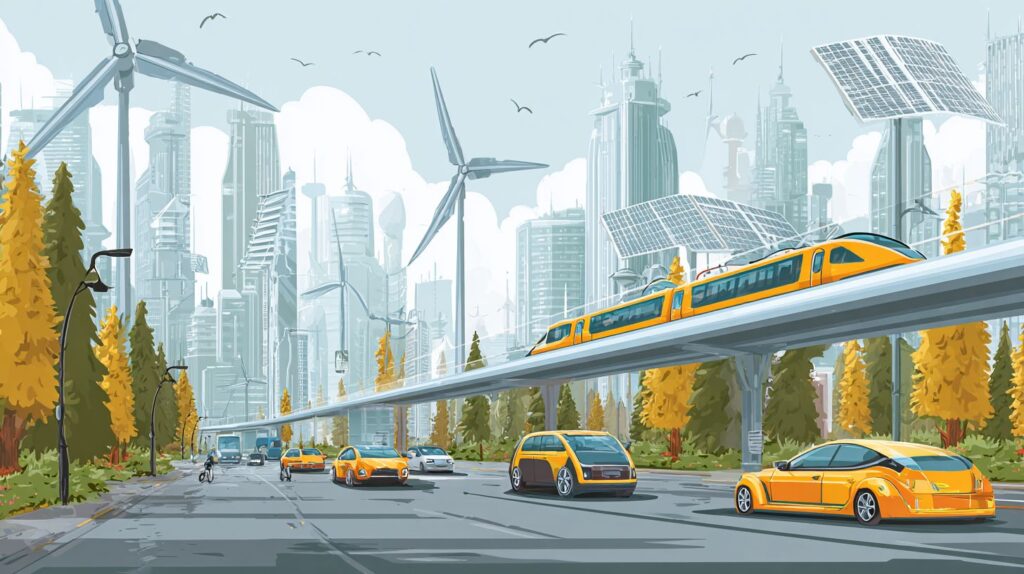
Singapore’s smart city initiatives integrate Autonomous Vehicles (AVs), driverless buses, and Vertical Take-Off and Landing (VTOL) shuttle services, leveraging blockchain technology for secure data sharing within digital twins to enhance the efficiency of public transportation systems.
To optimize this integration, authorities adhere to the following best practices:
- Deploy digital twins using Siemens NX software (at an annual cost of $10,000), which achieves 20% greater accuracy in traffic simulation by modeling real-time interactions among AVs with the aid of AI and the Internet of Things (IoT).
- Integrate AVs, such as Waymo’s driverless buses, which have been piloted across five districts in Singapore and have resulted in a 30% reduction in congestion during peak hours.
- Establish VTOL hubs equipped with Joby Aviation’s electric VTOL (eVTOL) aircraft, enabling 10-minute flights aligned with rush-hour schedules to provide seamless connectivity between Changi Airport and downtown areas.
PwC’s 2023 Smart Cities Report underscores the pivotal role of blockchain in achieving 99% data integrity, mitigating overlaps in Mobility-as-a-Service (MaaS) platforms, and supporting scalability to 1 million daily users by 2030.
Challenges in Adoption
The adoption of future transportation technologies presents several significant challenges, including interoperability gaps in freight management enhanced by Artificial Intelligence. Despite mandates for Sustainable Aviation Fuel (SAF), approximately 40% of EU logistics operations continue to rely on fossil fuels.
Key challenges encompass the following:
- Infrastructure costs: The European Union requires an investment of $100 billion to develop charging networks. These costs can be mitigated through public-private partnerships, exemplified by DHL’s model, which has achieved a 30% reduction in expenses according to SG Analytics reports on ESG services.
- Technological interoperability: This issue is highlighted by failures in the European Rail Traffic Management System (ERTMS) across Trans-European Transport Network (TEN-T) corridors. The implementation of standardized APIs for seamless data exchange can improve operational efficiency by 25%.
- Supply chain delays in battery technology: These are exacerbated by China’s dominance, which accounts for 80% of the global market. Diversification efforts can be supported by U.S. Inflation Reduction Act (IRA) subsidies, aimed at tripling domestic production by 2030.
- Regulatory barriers for autonomous vehicles (AVs): Safety concerns pose substantial obstacles. The adoption of ISO 26262 standards for system certification can reduce accident risks by 40%, as evidenced by SG Analytics studies.
Policy and Economic Outlook
European Union policies under the Green Deal, spearheaded by figures such as Apostolos Tzitzikostas, are designed to achieve carbon-neutral transport by 2050. This includes an allocation of EUR100 billion through the Trans-European Transport Network (TEN-T) to support the development of high-speed rail infrastructure, including Maglev Train technologies, and the adoption of sustainable aviation fuels (SAF).
This initiative is in alignment with the broader global transport decarbonization market, which Gartner projects to reach $1.2 trillion by 2030, as echoed by the International Energy Agency. Key drivers include incentives for sustainable aviation fuels and rail electrification, alongside innovations like Hyperloop.
For practical implementation, companies are encouraged to apply for European Union grants through the Innovation Fund, which has already disbursed EUR2.4 billion for low-carbon projects. These efforts are aimed at achieving a 55 percent reduction in emissions by 2030.
In comparison, the United States’ Inflation Reduction Act provides $369 billion in incentives, with projections indicating a 50 percent return on investment for electric vehicle (EV) adoption within five years, supported by tax credits of up to $7,500 per vehicle, similar to approaches in Japan and China.
China’s subsidies, which exceed $50 billion annually for electric vehicles and batteries, surpass those of the European Union by emphasizing large-scale manufacturing capabilities.
According to SG Analytics’ Environmental, Social, and Governance (ESG) reports, biofuels can deliver up to 20 percent cost savings. Looking ahead, incentives for hydrogen fuels have the potential to reduce emissions from heavy-duty transport by 80 percent by 2040, thereby recommending that firms initiate pilot programs for dual-fuel trucks at the present time.
Learn more, Transportation Industry Trends Shaping Public Transit In …
Frequently Asked Questions
What role do Electric Vehicles (EVs) play in The Future of Transportation: EVs, High-Speed Rail & Sustainable Travel?
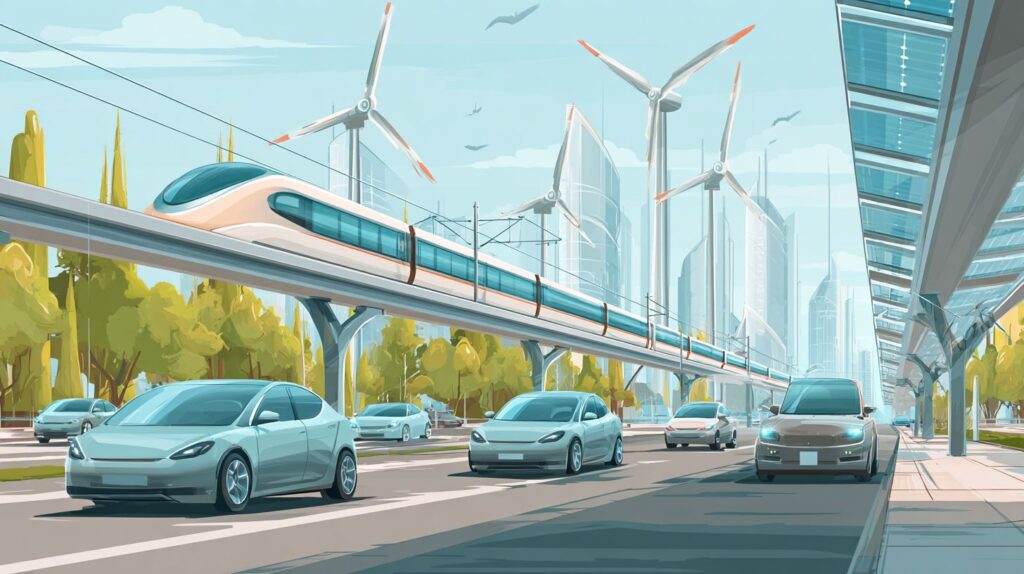
Electric Vehicles (EVs) are at the forefront of The Future of Transportation: EVs, High-Speed Rail & Sustainable Travel, offering zero-emission alternatives to fossil fuel-powered cars. They reduce carbon footprints by relying on renewable energy sources for charging, making them essential for sustainable urban mobility and long-distance travel.
How does high-speed rail enhance sustainable travel in The Future of Transportation: EVs, High-Speed Rail & Sustainable Travel?
High-speed rail is a cornerstone of The Future of Transportation: EVs, High-Speed Rail & Sustainable Travel, providing efficient, electrified networks that connect cities faster than cars or planes while emitting far less pollution per passenger. It promotes sustainable travel by encouraging shifts from air travel to rail, conserving energy and reducing overall emissions.
What are the environmental benefits of integrating EVs into The Future of Transportation: EVs, High-Speed Rail & Sustainable Travel?
Integrating EVs into The Future of Transportation: EVs, High-Speed Rail & Sustainable Travel significantly cuts greenhouse gas emissions and air pollution. With advancements in battery technology, EVs enable cleaner roadways, complementing high-speed rail to create a holistic sustainable travel ecosystem that minimizes reliance on non-renewable resources.
Why is high-speed rail considered vital for The Future of Transportation: EVs, High-Speed Rail & Sustainable Travel?
High-speed rail is vital in The Future of Transportation: EVs, High-Speed Rail & Sustainable Travel because it offers scalable, low-carbon solutions for mass transit. Unlike individual EVs, it transports thousands efficiently, reducing traffic congestion and supporting sustainable travel goals by integrating with EV charging hubs at stations.
How can sustainable travel practices evolve with EVs and high-speed rail in The Future of Transportation: EVs, High-Speed Rail & Sustainable Travel?
Sustainable travel practices in The Future of Transportation: EVs, High-Speed Rail & Sustainable Travel will evolve through seamless integration of EVs for short trips and high-speed rail for longer journeys, fostering multimodal systems. This approach promotes eco-friendly habits like carpooling with EVs and rail usage, drastically lowering global transportation emissions.
What challenges must be addressed to realize The Future of Transportation: EVs, High-Speed Rail & Sustainable Travel?
Realizing The Future of Transportation: EVs, High-Speed Rail & Sustainable Travel requires overcoming challenges like expanding charging infrastructure for EVs, funding high-speed rail projects, and policy support for sustainable travel. Innovations in renewable energy and international collaboration will help mitigate these hurdles for a greener mobility landscape.