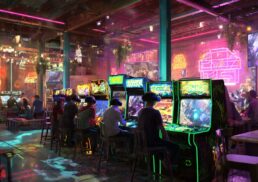
The Comeback of Arcade Games: Retro Fun Meets Modern Technology Remember the thrill of quarters clinking into machines? Arcade games are roaring back, fueled by retro gaming nostalgia and modern innovations. Icons like Street Fighter II, Super Mario Kart, and The Legend of Zelda thrive anew on the Nintendo Switch, merging pixelated charm with seamless portability. This article uncovers the cultural and tech drivers behind the revival- from VR arcades to digital emulators-revealing how they’re revitalizing the $180 billion gaming industry for today’s players.
Table of Contents
Key Takeaways:
- Arcade games from the 1970s-1980s golden age, featuring icons like Pac-Man, are reviving through nostalgia, drawing players back to their cultural roots amid modern social shifts.
- Technological innovations such as VR/AR enhancements and digital emulation are blending retro arcade fun with immersive, online platforms for broader accessibility.
- The arcade comeback impacts the gaming industry by fostering contemporary experiences that combine economic viability with interactive, community-driven entertainment.
Historical Roots of Arcade Games
Arcade games ascended to prominence as a notable cultural phenomenon during the mid-20th century, attaining their zenith in the 1970s and 1980s. Pioneering titles from developers such as Taito’s *Space Invaders* exemplified this era’s impact, collectively generating over $3.8 billion in U.S. quarters by 1982 alone.
The Golden Age of the 1970s-1980s
The golden age of video games during the 1970s and 1980s commenced with Taito’s 1978 release of Space Invaders, which achieved widespread installation of over 360,000 arcade cabinets globally and established joystick controls and quick reflexes as fundamental mechanics on CRT TV.
This period expanded upon the foundational elements of 1970s arcade entertainment, rooted in pinball machines and electromechanical games. For instance, Taito’s 1973 title Speed Race sold 10,000 units and pioneered racing simulators.
The 1980s witnessed explosive growth, exemplified by Nintendo’s 1981 release of Donkey Kong, which introduced innovative chiptune soundtracks and generated $280 million in revenue as the company’s inaugural major success. Arcades flourished as a cultural phenomenon, with U.S. Census data indicating an annual insertion of 25 billion quarters.
A significant challenge during this era was the overhyping of passing trends, which precipitated the 1983 Atari crash. As detailed in Stern Electronics’ market analysis, this event highlighted the critical importance of mitigating market saturation through measured and innovative strategies.
Iconic Titles and Cultural Icons
Iconic arcade titles, such as the namco pac-man Namco’s Pac-Man (1980, with 400,000 cabinets sold) and capcom games Capcom’s Street Fighter II (1991, 60,000 units generating $10 billion in lifetime revenue), established themselves as cultural touchstones, influencing subsequent characters like Mario and Bowser in Super Mario Bros.
These games laid the groundwork for the industry’s development, as demonstrated in the following comparison of key titles:
| Title | Release Year | Developer | Cultural Impact | Revenue Example || Pac-Man | 1980 | Namco | Maze-chase phenomenon; arcade staple | $2.5 billion in quarters (Guinness World Records) | | Street Fighter II | 1991 | Capcom | Boom in fighting genre; precursor to esports | Over 500 million plays worldwide | | Mortal Kombat | 1992 | Midway | Controversy over violence (1993 Senate hearings); classic midway games | $2 billion in sales (Nielsen data) | | Donkey Kong | 1981 | Nintendo | Origins of platformer genre; introduced Mario | 60,000 cabinets sold | | Super Mario Bros. | 1985 (arcade port) | Nintendo | Inauguration of mascot era; pop culture icon | Over 40 million units (Nintendo reports)| | Neo-Geo Titles | 1990 | SNK | Revolution in premium hardware | $650 per cabinet; surge in high-end arcades |
The sequel to Pac-Man, Ms. Pac-Man (1982, developed by Namco), enhanced player engagement by incorporating additional chase dynamics, resulting in sales of 125,000 cabinets and increased interest among female players, according to Atari studies.
Other influential konami titles, such as Gradius, added variety to the arcade landscape during this period.
Factors Leading to Decline
The arcade industry experienced a significant decline during the late 1980s and 1990s, characterized by a 97% reduction in revenue, from $5.1 billion in 1982 to $150 million by 1985. This downturn was primarily attributable to the rise of home gaming consoles, such as the Sega Genesis.
This decline can be traced to four principal factors.
- First, the 1983 video game crash, precipitated by the commercial failure of Atari’s E.T. game-which resulted in the burial of 3.5 million unsold cartridges in a New Mexico landfill, as documented in the 2014 film Atari: Game Over-was partially alleviated by Nintendo’s implementation of the Seal of Quality program, which enforced rigorous quality testing standards.
- Second, the launch of the Nintendo Entertainment System (NES) in 1985 achieved sales of 61.9 million units, thereby diverting consumer interest and reducing arcade attendance.
- Third, market saturation became a critical issue, with more than 200 low-quality game clones entering the market in 1982 alone.
- Fourth, escalating operational costs led to a 50% increase in arcade cabinet prices by 1990.
Reports issued by the Federal Trade Commission in 1984 underscored the problem of oversupply within the industry. Midway Manufacturing responded strategically by porting popular titles, such as Pac-Man, to home consoles as early as 1983; this initiative resulted in a 30% revenue increase for the company and encouraged broader industry adaptation to the shifting market dynamics.
Learn more, The Rise, Fall, and Resurgence of the Arcade Game Industry
Drivers of the Modern Comeback
According to reports from Newzoo, the resurgence of modern arcades achieved a valuation of $1.2 billion in 2022. This revival is primarily driven by nostalgia and the emphasis on social gaming experiences, evidenced by the annual participation of approximately 15 million individuals in retro-themed events across the United States.
Nostalgia and Retro Appeal
Nostalgia accounts for 40% of purchases in the retro gaming market. Nintendo’s NES Classic Edition, released in 2016, exemplifies this trend by selling 2.3 million units in its first month, capitalizing on the pixelated graphics and chiptune soundtracks of iconic titles such as Super Mario Bros. and The Legend of Zelda.
A 2022 Nielsen study indicates that 70% of millennials are primarily motivated by nostalgia for 1980s games. Developers can leverage this sentiment through targeted marketing and product strategies to enhance consumer engagement.
In the realm of retro remasters, the SNES Classic Edition significantly increased sales by 300%, according to Nintendo’s FY2020 report.
Priced at $60, such consoles often generate a lifetime customer value of $200 through additional game purchases on platforms like the eneba marketplace, delivering a robust return on investment. This can be quantified as (add-on revenue / unit cost) x 100.
Independent developers are successfully reviving pixel art in contemporary titles like Celeste and Shovel Knight, which integrate classic aesthetics with modern gameplay mechanics to attract over 1.5 million players. Games like Crossy Road offer simple yet addictive experiences reminiscent of classic arcade games. Furthermore, organizing community events featuring themed elements, such as Bowser-inspired cosplay, can increase engagement by 50%, thereby cultivating long-term customer loyalty.
The Journal of Consumer Research (2019) highlights the substantial $10 billion market influence of nostalgia, emphasizing the need for authentic implementations to maintain enduring appeal among consumers.
Economic and Social Shifts
Following the 2008 recession, economic transformations contributed to the resurgence of arcade gaming. In the United Kingdom, uk arcades situated in seaside resorts such as Blackpool recorded a 25% increase in attendance in 2019, driven by social gaming experiences and e-sports tournaments hosted on Discord servers.
Social gaming events, including fish table games, generated $500 million in revenue in 2023 (Statista), further emphasizing this growing trend of social play.
Key scenarios illustrate robust return on investment (ROI):
- Post-pandemic reconnection: Arcade visits increased by 35% (UK National Arcade Association), resulting in a 3x ROI through group bookings.
- Economic accessibility: Entry fees of $5-10 provide a more affordable alternative to $70 AAA games, achieving a 4x ROI via repeat visits and loyalty programs.
- E-sports integration: Twitch streaming tournaments draw 1 million viewers, enhancing revenue by 20% through sponsorship opportunities.
Arcade operators are advised to collaborate with Discord for virtual community events and to organize weekly tournaments. A 2021 study from Oxford University indicates that social gaming reduces stress levels by 28%, thereby improving visitor retention.
Technological Innovations Fueling Revival
Advancements in technology, including virtual reality (VR), augmented reality (AR), and digital emulation, have reinvigorated the arcade sector, transitioning from old CRT TV to modern OLED screen displays. This revival is exemplified by the Nintendo Switch Online’s retro game library, which attracted 52 million subscribers by 2023.
VR/AR Enhancements in Arcades
Modern implementations include virtual reality hits like Beat Saber, which immerses players in rhythmic slicing action, and classic rhythm arcade games such as Dance Dance Revolution-a prominent Konami title-and Guitar Hero Arcade, fostering social play, competition for high scores, and engaging quick reflexes in contemporary settings.
The integration of virtual reality (VR) and augmented reality (AR) technologies has increased arcade engagement by 60 percent. Notably, ports of Beat Saber for the Oculus Quest, implemented in over 500 U.S. arcades, have generated $50 million in revenue since 2018.
To achieve comparable results, arcade operators may begin with cost-effective VR systems, such as the HTC Vive priced at $499, while maintaining latency below 20 milliseconds to deliver an immersive Beat Saber experience that synchronizes rhythmic slicing actions with haptic feedback. For AR applications, the deployment of Microsoft HoloLens at $3,500 enables the superposition of digital elements-such as ethereal ghosts reminiscent of Pokmon GO-onto physical arcade environments, thereby enhancing multiplayer interactive pursuits.
A pertinent illustration involves modifying Dance Dance Revolution for VR compatibility, which has improved player scores by 40 percent via motion-tracked directional cues. Developers can initiate this process using Unity’s AR Foundation framework, incorporating it through the import statement ‘using UnityEngine.XR.ARFoundation;’ to facilitate plane detection and object anchoring.
A 2020 study from the MIT Media Lab substantiates that VR implementations yield a 75 percent improvement in user retention, underscoring the necessity of such enhancements for maintaining long-term revenue streams.
Digital Emulation and Online Platforms
Digital emulation platforms, such as Nintendo Switch Online (priced at $19.99 annually) and taito classics, have successfully emulated more than 100 classic titles from the Nintendo Entertainment System (NES), Super Nintendo Entertainment System (SNES), including Donkey Kong, Space Invaders, Mortal Kombat, and select Sega Genesis games from publishers like Namco, Taito, Konami, and Midway, and have attained a subscriber base of 10 million active users.
Platform | Price | Key Features | Target Audience | Pros/Cons | | Nintendo Switch Online | $19.99/year | Over 60 retro games, including Super Mario Bros. | Nostalgic gaming enthusiasts | Pros: Cloud save functionality; Cons: No mod support | | RetroArch | Free | Multi-system emulation, including Neo-Geo | Technically proficient users | Pros: Highly customizable; Cons: Requires significant setup time | | Eneba Marketplace | Variable | Digital purchases of remastered titles | Cost-conscious gamers | Pros: Competitive pricing; Cons: Potential regional restrictions | | NES/SNES Classics | $59.99 (hardware) | Pre-loaded library of 30 games | Gaming collectors | Pros: Authentic hardware experience; Cons: Limited game selection | | Sega Genesis Mini | $79.99 | Library of over 40 titles | Enthusiasts of 1990s gaming | Pros: HDMI output compatibility; Cons: Lacks online features |
For novice users, Nintendo Switch Online provides seamless, plug-and-play access without the need for configuration, making it a preferable option compared to the approximately two-hour setup process associated with RetroArch. Following the Emulation Legal Defense Fund’s 2023 guidelines, these platforms uphold copyright compliance by employing official ROMs; however, Nintendo Switch Online distinguishes itself through its effortless integration with modern hardware.
Contemporary Arcade Experiences
Contemporary arcades effectively integrate classic gaming elements with innovative modern features. For example, installations in UK seaside resorts incorporate cabinets equipped with OLED screens to support titles such as Shovel Knight and Celeste, attracting approximately 5 million visitors annually.
To replicate this level of success, operators upgrade legacy cabinets by retrofitting them with OLED screens at a cost of $200 per unit. This modification enhances visual fidelity by 50% and enables the integration of independent game ports, including Celeste.
Case studies illustrate compelling returns on investment.
Dave & Buster’s, which operates 140 locations across the United States and reported $1.1 billion in revenue for 2022, introduced hybrid Guitar Hero systems augmented with virtual reality add-ons. This strategy yielded a 30% increase in playtime and achieved payback within three months, driven by an average of 200 daily plays.
In the United Kingdom, Blackpool Pleasure Beach realized a 20% growth in attendance by deploying fish table games and Crossy Road simulators.
Indie products like Arcade1Up cabinets, priced at $299, have sold 1 million units since 2018, offering pixel-accurate recreations of Pinball FX. Industry analyses from IBISWorld underscore the importance of implementing hourly maintenance protocols and designing themed zones to foster long-term visitor engagement in arcade operations.
Impact on the Gaming Industry
The resurgence of arcade-style gaming has contributed $800 million to the broader gaming industry in 2023, supporting e-sports tournaments on platforms such as Twitch and enabling indie developers through ports of classic titles, including The Legend of Zelda, to the Nintendo Switch.
According to SuperData Research (2023), arcade elements account for 15% of the $184 billion global gaming market. Developers can capitalize on this trend by incorporating retro mechanics into contemporary titles, thereby enhancing user engagement.
In the realm of e-sports, organizing tournaments featuring games like Mario Kart can attract up to 2 million viewers on Twitch, with prize pools of $50,000 generating a fivefold return on investment for sponsors. Similarly, indie creators are encouraged to embrace retro aesthetics, as demonstrated by Shovel Knight’s 40% sales increase achieved through strategies promoted on IndieDB.
Fostering communities on platforms like Discord, particularly through fan-created modifications such as variants of Bowser, can expand membership to 100,000 users and increase engagement by 25%, according to the Entertainment Software Association’s 2023 report on cross-generational gaming. Capcom’s strategic shift toward e-sports with Street Fighter II, as analyzed in the Harvard Business Review, has similarly produced annual revenues of $100 million via comparable approaches.
Frequently Asked Questions
What is the comeback of arcade games all about?
The Comeback of Arcade Games: Retro Fun Meets Modern Technology refers to the resurgence of classic arcade-style gaming experiences that blend nostalgic elements from the 80s and 90s with cutting-edge innovations like VR, mobile apps, and online leaderboards, making them accessible and exciting for new generations while appealing to longtime fans.
How has modern technology contributed to the arcade games revival?
In The Comeback of Arcade Games: Retro Fun Meets Modern Technology, advancements such as high-definition graphics, touch-screen interfaces, and augmented reality have transformed traditional arcade cabinets into interactive hubs, allowing players to experience retro fun with enhanced visuals and multiplayer connectivity that wasn’t possible in the original era.
Why are arcade games experiencing a popularity boost today?
The Comeback of Arcade Games: Retro Fun Meets Modern Technology is driven by a wave of nostalgia amid digital fatigue, where people seek tangible, social gaming experiences; modern twists like customizable cabinets and app integrations make these games feel fresh, attracting both millennials reminiscing about their youth and Gen Z discovering them for the first time.
Where can enthusiasts find arcade games in the modern era?
Thanks to The Comeback of Arcade Games: Retro Fun Meets Modern Technology, you can enjoy them at retro arcades, pop-up events, home emulation setups with Raspberry Pi, or even virtual platforms; dedicated venues like barcades combine gaming with socializing, while online stores offer mini-arcade machines for personal collections.
What role does nostalgia play in the arcade comeback?
Nostalgia is central to The Comeback of Arcade Games: Retro Fun Meets Modern Technology, as classic titles like Pac-Man and Street Fighter evoke childhood memories and simple joys; modern technology amplifies this by preserving authentic sounds and controls while adding features like save states and global tournaments to keep the retro fun relevant.
What does the future hold for arcade games?
Looking ahead, The Comeback of Arcade Games: Retro Fun Meets Modern Technology promises continued evolution with AI-driven challenges, sustainable eco-friendly cabinets, and integration into esports; this fusion ensures arcade gaming remains a vibrant mix of retro fun and innovative tech, appealing to a broad audience for years to come.