In the evolving world of Digital vs. Traditional Printing, the choice between Print on Demand flexibility and robust Offset Printing can define your project’s success. Digital Printing excels in low upfront costs and quick turnaround, while traditional printing delivers superior print quality for high-volume runs. This guide compares costs, speed, and sustainability to empower you in selecting the ideal service for your unique needs.
Table of Contents
Key Takeaways:
- Digital printing suits short runs with quick turnaround and variable data, ideal for prototypes or personalized items, while traditional offset excels in high-volume production for cost efficiency per unit.
- Upfront costs for traditional printing are higher due to setup, but per-unit expenses drop significantly for large quantities; digital offers lower initial investment but higher costs for bulk orders.
- Consider speed, quality, and sustainability: digital provides faster results and eco-friendly options for small batches, whereas traditional delivers superior color accuracy and durability for mass marketing materials.
Digital Printing Basics
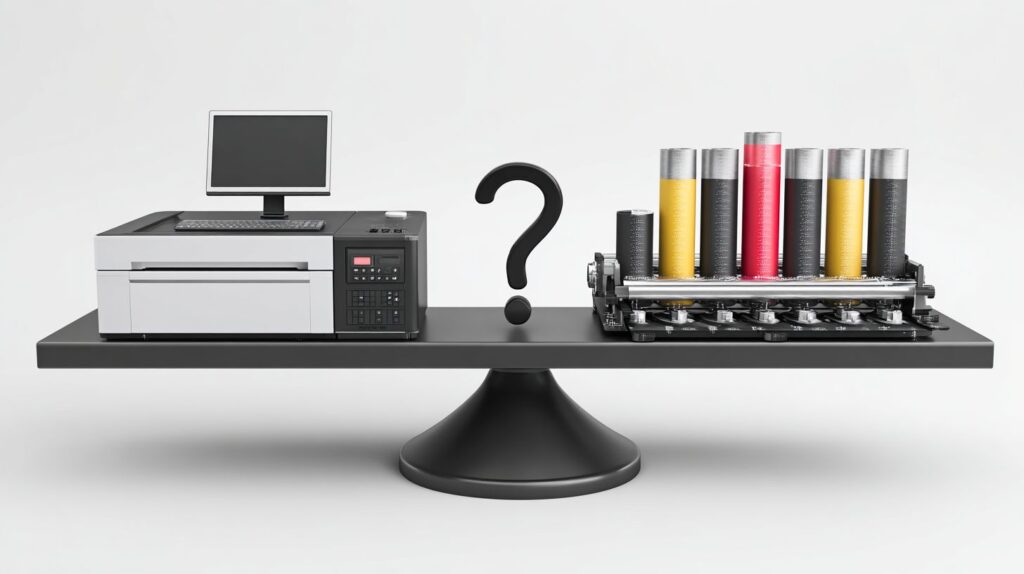
Digital printing transforms the production process for small quantities by eliminating the need for plates, thereby enabling turnaround times as short as 24 hours through the use of inkjet or laser technologies. This approach is particularly beneficial for self-publishers aiming to minimize the risk of unsold inventory.
How Digital Printing Works
Digital printing functions by transferring digital files directly onto paper through inkjet or laser technologies, employing CMYK or RGB color models to generate variable data prints on various paper substrates without the need for setup plates.
To initiate the process and achieve optimal output quality, adhere to the following structured steps:
- Prepare files using Adobe InDesign, verifying a resolution of 300 DPI to ensure image clarity (approximately 10 minutes; consult NIST SP 1800-11 guidelines for color management to uphold precision).
- Execute printing with the HP Latex 335 printer, popular in locations like Barcelona, which delivers vibrant, environmentally sustainable results via water-based inks and eco-friendly recyclable materials. Calibrate RGB to CMYK profiles to prevent color discrepancies, particularly for variable data applications such as customized brochures.
- Perform post-processing with appropriate binding styles and techniques, including spines and saddle stitching for 8-page booklets (5-10 minutes), while considering shipping requirements.
For specialized technical uses, such as blueprint printing for architectural heritage, inkjet printing and laser printing facilitate the application of white ink prints on dark fabrics, making it suitable for bespoke apparel production.
Learn more, What is Digital Printing: How It Works, Best Applications & …
Ideal Applications for Digital
Digital printing is particularly effective for applications that require small quantities and a high degree of customization options, such as self-published books distributed through online platforms like Amazon or bespoke merchandise tailored to niche markets for self-publishers and small businesses. According to Bowker’s 2022 report, 70% of independent authors employ this method.
Optimal applications include:
- Self-published books: Producing 50 copies via IngramSpark, which eliminates storage costs for independent authors.
- Marketing materials: Developing premium brochures using variable data printing for personalized event invitations, resulting in a 30% increase in engagement (as reported in a study by the Printing Industries of America).
- Custom merchandise: Manufacturing t-shirts with unique designs for fan events, such as limited runs of 100 units for band merchandise.
- Niche markets: Short-run art books (under 200 copies) for galleries, consistent with print-on-demand trends outlined by BookNet Canada.
- Event swag: Personalized badges for conferences.
This methodology reduces handling costs by 50% for orders under 100 units. A practical recommendation is to connect with Printful for streamlined e-commerce distribution.
Traditional Printing Fundamentals
Traditional printing techniques, particularly offset lithography, offer superior print quality for large-volume production runs through the precise transfer of ink via printing plates. This approach is well-suited to professional publications and bulk orders, where the upfront setup costs are justified by the scale of the project.
The Offset Printing Process

Offset printing is a sophisticated process that involves the creation of metal plates from digital files, followed by the transfer of ink through rollers to achieve precise color matching in the CMYK color model on selected paper stocks. This method ensures exceptional print quality, particularly for production runs exceeding 500 units.
To implement this process effectively and achieve optimal results, adhere to the following structured steps:
- Prepress Phase: Utilize Raster Image Processor (RIP) software, such as Esko Automation Engine or Adobe PDF Print Engine, to etch the plates. Allocate 1 to 2 hours for this stage and verify that all images maintain a resolution exceeding 300 DPI to prevent blurry text-a common pitfall identified in printing industry guidelines.
- Press Setup: Align the CMYK color separations on specialized equipment, such as Heidelberg Speedmaster presses. Perform a 30-minute calibration to ensure color fidelity in accordance with ANSI/CGATS.21-2013 standards.
- Printing and Finishing: Execute production runs at a rate of 5,000 to 10,000 sheets per hour. Subsequently, apply appropriate finishing techniques, including perfect binding for books (requiring 4 to 6 hours for 1,000 units) or foil stamping for premium brochures, which enhances their luxurious appeal through metallic effects.
Common Uses for Traditional Methods
Offset printing remains a cornerstone of traditional printing methods, particularly suited for large-scale production runs in professional publications such as art books and conference materials. The exceptional quality achieved through this technique justifies the associated costs for volumes exceeding 1,000 units.
Offset printing, a key form of traditional printing and Offset Printing, demonstrates particular efficacy in four principal applications, including those with specific shipping requirements.
- Book publishing: Retailers like Barnes & Noble frequently commission runs of 5,000 or more copies for bestselling titles, achieving a 20% higher profit margin compared to digital formats, owing to the use of premium binding and paper stock.
- Art books: The utilization of high-gloss paper preserves vibrant colors with precision, making it ideal for galleries that produce editions of 2,000 units, incorporating exact Pantone color matching at a cost of $3 to $5 per book.
- Trade show materials: Large-scale offset printing for banners reduces per-unit costs to $0.50, facilitating print volumes of 10,000 or more while employing weather-resistant inks for durability.
- Professional publications: Magazines often employ sophisticated binding techniques, such as perfect binding or saddle stitching, for runs of 15,000 issues, thereby ensuring the retention of sharp, high-resolution images.
As an illustrative example, PCG in College Station, Texas, produced 10,000 brochures via offset printing, resulting in a 30% cost reduction relative to Digital Printing proofing methods, even extending to creative uses like recyclable cardboard furniture packaging.
Cost Comparison
A cost comparison between digital and traditional printing methods underscores the advantages of digital printing for small production runs, where upfront costs are typically under $100. In contrast, offset printing proves more economical for large-volume runs, with per-unit costs decreasing from $2.00 to $0.20.
Upfront vs. Per-Unit Expenses
Offset printing generally incurs upfront costs averaging $1,000 for plates and setup, in stark contrast to the negligible initial expenses associated with digital printing. However, the per-unit cost for offset printing decreases substantially to $0.15 for runs of 5,000 units, compared to $1.50 for smaller quantities produced via digital methods.
To facilitate an effective comparison, please review the following breakdown:
| Method | Upfront Cost | Per-Unit (100 units) | Per-Unit (1,000 units) | Breakeven Point | Example ROI |
|---|---|---|---|---|---|
| Digital Printing | $0 | $3 | $1 | 200 units | 40% margin for custom merch |
| Offset Printing | $800 | $5 | $0.30 | 800 units | 60% margin for bulk books |
According to a 2022 PrintNinja study on small print runs, Print on Demand digital printing for 500 self-published books yields $400 in savings on unsold inventory costs relative to offset printing. To minimize expenses further, small businesses and organizations may utilize just-in-time printing services such as IngramSpark, which provide on-demand production without the need for upfront bulk orders and can reduce waste by up to 70% for independent authors, considering the environmental impact.
Speed and Quality Differences
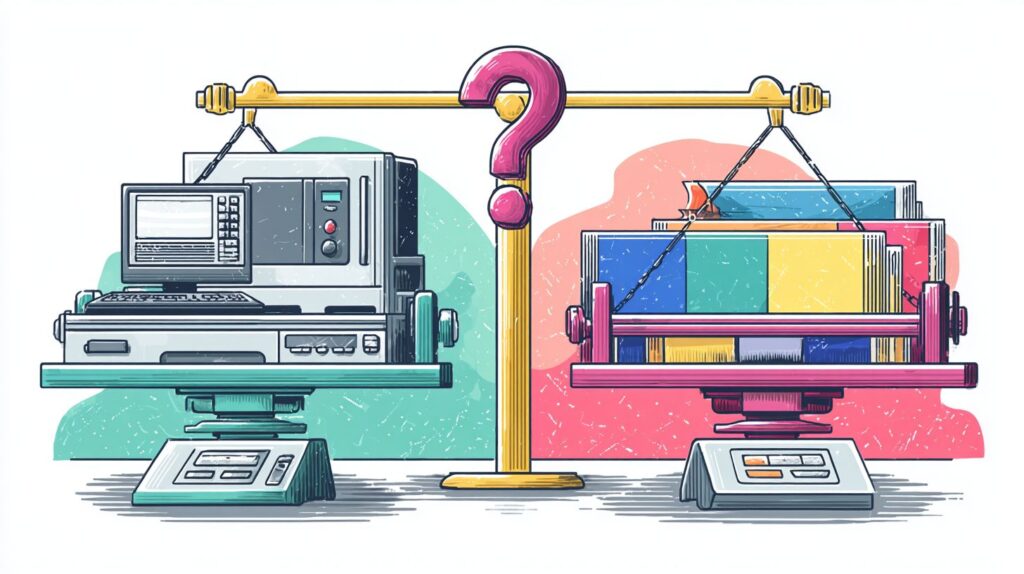
Digital printing provides rapid turnaround times of 1 to 3 days, delivering vibrant colors and clear text suitable for short print runs, whereas traditional offset printing offers superior quality, product quality, and precise color matching, albeit with an initial setup period of 7 to 14 days.
For initiatives such as promotional flyers or prototypes, digital printing is particularly advantageous due to its low minimum order quantities (fewer than 100 units) and cost efficiency, ranging from $0.10 to $0.50 per page, according to data from PrintNinja.
Offset printing is optimal for large print runs and large-scale projects, such as catalogs exceeding 1,000 copies for trade shows and conferences, where it achieves 95% compliance with ISO 12647 standards for sharp text rendering and clear text-compared to digital printing’s 85%-and minimizes ink bleed in premium art books, as evidenced by studies from the Graphic Arts Technical Foundation (GATF), with superior product quality.
Furthermore, offset printing yields approximately 20% higher customer satisfaction rates in professional publications.
To ensure optimal results, it is advisable to verify color accuracy using Pantone Matching System guides for CMYK and RGB profiles prior to production commitments.
For hybrid approaches, consider integrating digital proofs with offset manufacturing to achieve an effective balance between speed and quality.
Environmental and Sustainability Factors
Digital printing significantly reduces environmental impact compared to traditional offset printing. It achieves this through on-demand production, which minimizes waste by up to 30%, and the use of eco-friendly inks.
In contrast, offset printing typically consumes more resources; however, it can incorporate recyclable materials to enhance sustainability.
To mitigate waste challenges, it is noteworthy that offset printing generates 15% more paper waste than digital methods, according to Environmental Protection Agency (EPA) data. Organizations can address this by transitioning to Print on Demand (POD) models, which can reduce unsold inventory by as much as 50%.
Regarding inks, digital printing utilizes water-based formulations, whereas offset printing relies on petroleum-based options. For optimal environmental performance, printers such as the HP Latex 335, which emit low levels of volatile organic compounds (VOCs), are recommended.
Overall, digital printing demonstrates a 25% lower carbon footprint, as evidenced by a 2022 study from the Massachusetts Institute of Technology (MIT).
A compelling real-world case is Barcelona’s eco-print initiative, which employed recyclable cardboard in the production of furniture prototypes. This approach reduced landfill waste by 40% and advanced principles of the circular economy.
Choosing the Right Service for Your Needs
Selecting a printing service requires a thorough evaluation of factors such as customer service, shipping requirements, and distribution channels like Amazon and Barnes & Noble. For urgent blueprint printing in architectural heritage projects, local print shops in College Station, Texas are particularly suitable.
To facilitate an optimal selection, adhere to the following best practices:
- Assess production volume: For print runs of fewer than 500 units, employ digital printing through online platforms such as Lulu, which offers shipping in 2-5 days at a starting rate of $5 per unit for books with custom Spines.
- Verify quality specifications: Request complimentary samples to confirm color accuracy, including Pantone matching for heritage blueprints.
- Evaluate sustainability credentials: Select providers certified by the Forest Stewardship Council (FSC), such as Blurb or PCG, to ensure environmentally responsible paper sourcing, which can reduce environmental impact by up to 30% according to FSC studies.
- Review service capabilities: For small businesses, consider Vistaprint, which provides 24/7 customer support and expedited processing options.
Key performance checklist: Target a defect rate of less than 5% and an on-time delivery rate of at least 95%. For instance, a small firm utilized Printful for conference merchandise and realized a 35% increase in sales attributable to its 48-hour turnaround times.
Frequently Asked Questions
What is the key difference between digital and traditional printing in the context of ‘Digital vs. Traditional Printing: Which Service Is Right for Your Needs?’
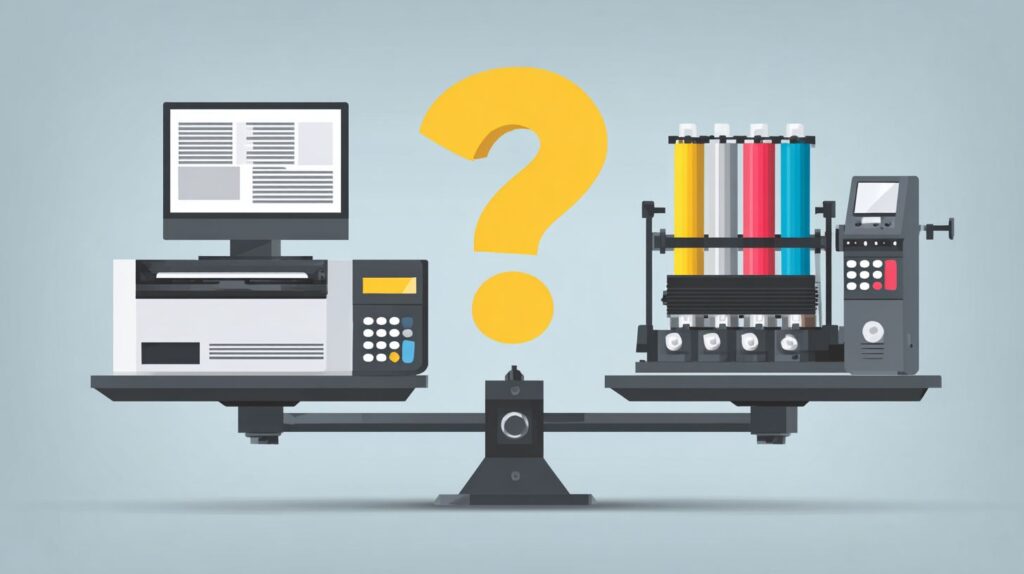
Digital printing uses electronic files and inkjet or laser technology to produce prints directly without plates, making it ideal for short runs and quick turnaround. Traditional printing, often offset, relies on plates and chemical processes for high-volume production, offering superior quality for large quantities. Deciding between them depends on your project’s scale, budget, and deadlines as outlined in ‘Digital vs. Traditional Printing: Which Service Is Right for Your Needs?’.
When should I opt for digital printing over traditional for my project?
Choose digital printing when you need small quantities, variable data like personalized marketing materials, or fast delivery times, as it eliminates setup costs associated with plates. In ‘Digital vs. Traditional Printing: Which Service Is Right for Your Needs?’, digital is recommended for prototypes, on-demand items, or when flexibility is key, avoiding the waste and time of traditional methods.
What are the advantages of traditional printing for larger print jobs?
Traditional printing excels in high-volume runs due to lower per-unit costs after initial plate setup, providing vibrant colors and sharp details on various substrates. According to ‘Digital vs. Traditional Printing: Which Service Is Right for Your Needs?’, it’s the better choice for books, brochures, or packaging in bulk, where the investment in setup yields long-term savings and premium quality.
How do costs factor into deciding between digital and traditional printing services?
Digital printing has higher per-unit costs but no upfront setup fees, suiting low-volume or rush jobs economically. Traditional printing’s costs drop significantly with volume, making it cost-effective for thousands of copies. ‘Digital vs. Traditional Printing: Which Service Is Right for Your Needs?’ advises evaluating your quantity and budget to determine which service aligns best with your financial goals.
What about print quality: does digital or traditional printing offer better results?
Traditional printing generally provides higher quality with richer colors and finer details, especially on textured papers, due to its mechanical precision. Digital printing has improved but may show slight banding in large areas. In ‘Digital vs. Traditional Printing: Which Service Is Right for Your Needs?’, quality needs should guide your choice-traditional for professional finishes, digital for functional, quick outputs.
How does turnaround time differ in digital vs. traditional printing, and why does it matter for my needs?
Digital printing offers rapid turnaround, often same-day or within 24 hours, as it skips plate-making. Traditional printing takes longer, typically days to weeks, due to preparation. ‘Digital vs. Traditional Printing: Which Service Is Right for Your Needs?’ emphasizes that if time is critical, like for events or updates, digital is preferable; otherwise, traditional suits planned, large-scale projects.