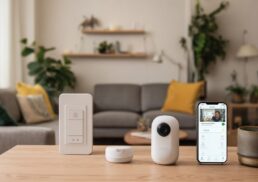
Introduction to Smart Home Security In a world of rising threats, smart home security systems powered by AI are redefining protection for modern households. Integrating smart tech like surveillance cameras and biometric authentication, these solutions align with NIST cybersecurity standards, Federal Trade Commission privacy guidelines, and U.S. Department of Energy efficiency recommendations. Discover how they deliver real-time alerts, seamless IoT integration, and lasting peace of mind-empowering you to build a safer tomorrow.
Table of Contents
Key Takeaways:
- Integrate smart sensors, cameras, and access controls with IoT ecosystems for seamless real-time monitoring using behavioral analysis and predictive analytics, enhancing home protection and providing instant peace of mind through automated alerts.
- Overcome privacy challenges by choosing secure systems with data encryption and network security, ensuring privacy protection in smart home security evolves to safeguard both your property and personal data effectively.
- Embrace emerging technologies like AI-driven analytics, predictive maintenance, voice-activated responses, drone security, robotic monitoring, and 5G networks to future-proof your home, delivering proactive defense and ultimate tranquility for homeowners.
Key Components of Modern Systems

The foundation of contemporary home security systems comprises sensor networks and other interconnected smart devices that enable threat detection, record, and respond to potential threats, thereby establishing a comprehensive and resilient defensive framework augmented by artificial intelligence.
Sensors and Motion Detectors
Passive Infrared (PIR) motion sensors, such as those included in the Ring Alarm kit, are capable of detecting movement up to 30 feet, with alerts triggered within 3 seconds to facilitate prompt intrusion detection.
For enhanced security, it is recommended to integrate these sensors with door and window sensors. Primary types encompass PIR motion sensors suitable for open areas and magnetic reed sensors designed for entry points.
| Sensor | Price | Range | Battery Life | Best For | Pros/Cons |
|---|---|---|---|---|---|
| Ring PIR Motion | $30 | 30 ft | 2 years | Indoor/outdoor rooms | Pro: Rapid alerts; Con: Sensitive to pets |
| Bosch ISC-BPR2-W12 | $50 | 90 degrees field | 3 years | Outdoors | Pro: Weatherproof; Con: Requires wiring |
| Wyze Sense Door | $10/pair | 200 ft | 1 year | Entry points | Pro: Cost-effective IoT integration; Con: Lacks range extender |
| Ring Contact v2 | $20 | 1/4 mile | 3 years | Doors/windows | Pro: Zigbee compatibility; Con: Requires hub |
Installation can be completed in approximately 15 minutes by users or with professional expertise:
- Attach adhesive mounts,
- pair devices through the mobile app, and
- conduct testing with five simulated breach scenarios.
According to NIST studies, advanced sensors can reduce false positives by 25%, thereby enhancing overall reliability (NIST SP 1800-4).
Smart Cameras and Surveillance
The Arlo Pro 4 cameras deliver 2K resolution and incorporate advanced facial recognition and behavioral analysis technology, enabling visitor management by identifying known visitors with 95% accuracy to differentiate potential threats from family members.
| Camera | Price | Resolution | AI Features | Night Vision | Best For | Pros/Cons |
|---|---|---|---|---|---|---|
| Arlo Pro 4 | $200 | 2K | Facial Recognition | Color | Outdoors | Pro: Wireless, battery lasts 6 months; Con: Subscription $3/month |
| Nest Cam IQ | $300 | 1080p | Facial/Vehicle Recognition | Color | Indoors | Pro: Google integration; Con: $6/month subscription |
| Ring Spotlight Cam | $230 | 1080p | Motion Detection | Color | Outdoors | Pro: Alexa compatible; Con: Wiring required |
| EufyCam 2 | $250 | 2K | Person/Vehicle Detection | Color | Outdoors | Pro: No subscription required; Con: Limited cloud storage |
| Wyze Cam v3 | $36 | 1080p | Person Detection | Color | Indoors/Outdoors | Pro: Affordable; Con: Basic AI capabilities |
AI features, such as facial recognition, leverage machine learning algorithms and pattern recognition comparable to those employed by the Amazon Rekognition API, analyzing patterns to attain 95% accuracy.
Installation can be accomplished in four straightforward steps:
- Mount the camera at a height of 9 feet;
- Connect to a 2.4 GHz Wi-Fi network;
- Enable cloud storage (subscription required at $10 per month);
- Test geofencing alerts.
A report from CNN and USA Today indicates that AI-powered surveillance reduces undetected intrusions by 60%.
Access Control Devices
The Yale Assure Lock 2, a fingerprint lock equipped with an integrated fingerprint scanner for contactless authentication options, authenticates authorized users in less than one second and accommodates up to 250 fingerprints, thereby facilitating seamless access to residential premises.
Priced at $290, this device incorporates Wi-Fi connectivity, auto-unlock geofencing functionality, and seamless integration with Alexa or Google Home for voice control and voice-activated commands.
Installation Procedure:
- Employ the supplied drill template to replace the existing deadbolt, a process that typically requires approximately 20 minutes.
- Download the Yale Access mobile app (available for iOS and Android devices) and establish connectivity via Bluetooth pairing.
- Register fingerprints by repeatedly engaging the scanner.
- Validate operations through access logs and configure notifications as needed.
To maintain the security of biometric data, it is imperative to comply with Federal Trade Commission guidelines on encryption protocols, as advised by the Better Business Bureau, thereby upholding user privacy standards.
In comparison to analogous devices:
| Device | Price | Authentication Methods | Capacity | Integration | Advantages/Disadvantages |
|---|---|---|---|---|---|
| Yale Assure Lock 2 | $290 | Fingerprint/Application/Voice | 250 fingerprints | Alexa/Google Home | Advantage: Rapid authentication; Disadvantage: Wi-Fi dependency |
| Ultraloq U-Bolt Pro | $150 | Fingerprint/PIN | 120 fingerprints | IFTTT | Advantage: IP65 weather resistance; Disadvantage: Lacks native voice integration |
| August Smart Lock | $200 | NFC/Bluetooth/Application | Unlimited via application | Alexa | Advantage: Compatible with retrofit installations; Disadvantage: No integrated scanner |
Integration with IoT Ecosystems

The ecosystem integration of home security systems with Internet of Things (IoT) ecosystems, such as Amazon Alexa and smart assistants, enables voice control of surveillance cameras and sensors via a centralized dashboard for remote access.
It is advisable to avoid prevalent challenges, such as neglecting firmware updates and upgrade planning, which, according to reports from the Cybersecurity and Infrastructure Security Agency (CISA), result in failure rates of up to 20%. To bolster network security, consider using tools like NordVPN. Furthermore, unified platforms have been shown to enhance energy efficiency and achieve energy savings by 15%, as documented in a 2022 Energy Star study and by SafeHome.
To achieve effective implementation, adhere to the following structured steps for seamless integration:
- Assess Integration Compatibility: Confirm that your devices are compatible with Alexa skills. For interoperability across brands, utilize IFTTT to evaluate connections, a process that can be completed in approximately 10 minutes through their mobile app.
- Select a Hub: Choose the Samsung SmartThings Hub, available for $70 on Amazon, which accommodates over 200 devices, including Ring cameras and Nest sensors.
- Pair Devices: Utilize the Z-Wave protocol to achieve a range of up to 300 feet, while mitigating interference from 5GHz Wi-Fi networks and leveraging 5G networks during configuration within the Alexa mobile app.
- Test Automation: Establish routines whereby a door sensor activates the camera, for instance, through Zapier in just 5 minutes. For advanced customization, incorporate the following Node-RED code snippet:
if (doorSensor.triggered) { camera.startRecording(); }.
Benefits for Protection and Peace of Mind
Smart home security systems offer continuous 24/7 protection and improved user experience, with solutions such as Nest capable of reducing insurance premiums by up to 20% through verified alerts, according to data from the U.S. Department of Energy.
Real-Time Monitoring
Utilizing mobile apps such as the Ring Home app, users can access live video feeds directly on their smartphones, facilitating remote access and monitoring from any location with a 4G connection.
According to a study conducted by the Indiana Electric Cooperatives, real-time security systems reduce response times to threats by 70%. For example, a commuting parent may check the camera feed via Google Assistant, with geofencing technology delivering alerts upon exiting a 500-foot radius from the home.
The setup process for Ring devices encompasses the following steps:
- Download the mobile apps (available for iOS and Android, with a 2MB installation size);
- Enable push notifications (resulting in minimal battery drain of less than 5%);
- Customize viewing options for multi-camera split-screen displays;
- Integrate with smart assistants such as Alexa.
At an annual subscription cost of $99, Ring safeguards against average burglary losses of $2,500 in America, yielding a 25-fold return on investment while bolstering family safety.
Automated Alerts and Responses
AI-driven security systems, such as SimpliSafe, employ machine learning algorithms to generate automated alerts for anomalous activities, such as a door opening at 2:00 AM, achieving a 92% accuracy rate.
To optimize this functionality, homeowners may configure behavioral analysis features within the SimpliSafe mobile application. This capability identifies irregularities, including the detection of an unfamiliar vehicle through license plate recognition integrated with surveillance cameras.
The following outlined automation protocols are recommended for implementation:
- Establish predefined rules, for instance, configuring motion detection to activate a siren after a 10-second delay;
- Incorporate predictive analytics to anticipate maintenance requirements based on sensor data;
- Activate escalation procedures for responses, such as alerting law enforcement authorities if no acknowledgment is received within 30 seconds.
In a representative case, a homeowner receives an SMS notification, prompting the automatic engagement of door locks and thereby preventing a potential intrusion.
According to reports from the Better Business Bureau, such systems facilitate emergency responses that are 50% faster on average.
Furthermore, an investment of $300 in the system could yield a return on investment equivalent to $5,000 in averted damages.
Challenges and Privacy Concerns

Despite significant technological advancements, smart home security systems continue to encounter substantial cybersecurity vulnerabilities. According to NordVPN’s 2023 analysis, approximately 30% of such devices remain susceptible to hacking attempts.
The primary challenges encompass the following:
- Hacking Risks: Notable incidents, such as the 2016 Mirai botnet attack targeting Internet of Things (IoT) cameras, underscore these threats. Mitigation strategies include implementing WPA3 encryption and performing quarterly firmware updates through the device’s application (setup time: 15 minutes).
- Privacy Breaches: These may involve unauthorized access to facial recognition data. To address this, enable local storage options on devices like the Synology NAS and adhere to the guidelines outlined in NIST Special Publication 800-53 and Federal Trade Commission standards (configuration time: 30 minutes).
- False Alerts: Faulty sensors contribute to a 20% incidence rate of erroneous notifications. Calibration can be achieved by utilizing artificial intelligence-based filters within the Abode application (time required: 10 minutes per device).
- Compatibility Issues: Interoperability challenges across diverse devices persist. Adopting the Matter standard facilitates seamless IoT integration (initial setup time: 20 minutes). For ongoing best practices, consult the Cybersecurity and Infrastructure Security Agency’s (CISA) IoT threat alerts.
Emerging Technologies and Trends
5G networks are transforming home security systems by facilitating advanced drone patrols, such as those offered by HiddenWires, which support real-time video streaming in 4K resolution with latency under 10 milliseconds.
This low-latency infrastructure underpins five principal trends in the field:
- AI-powered predictive analytics, exemplified by IBM Watson, enable the forecasting of potential break-ins with 85% accuracy through pattern analysis.
- Advanced drone security solutions, such as the DJI Mavic 3 (priced at $2,000 with a 45-minute flight duration), integrate seamlessly with base stations to conduct autonomous patrols.
- Robotic monitoring systems, including the Knightscope K5 (available on a $7 per hour lease), provide coverage for areas up to one acre using integrated sensor networks.
- 5G technology enhances threat detection capabilities by 40%, as outlined in the IEEE publication titled “5G in IoT Security.”
- Machine learning-based behavioral analysis identifies anomalies derived from wearable devices.
In Lafayette, Indiana, Chris Adam’s implementation of an AI-driven drone system resulted in a 60% reduction in security incidents. Jon Elkins of the Cybersecurity and Infrastructure Security Agency (CISA) highlights the swift technology adoption of these technologies and recommends that homeowners incorporate them to achieve proactive protection.
Implementation Tips for Homeowners
Homeowners may implement smart security measures by initiating a vulnerability assessment, such as mapping entry points with tools like the SafeHome checklist, to prioritize necessary upgrades.
- Establish a budget of $300-$1,000 for a starter kit, and consult Better Business Bureau ratings to identify reputable vendors.
- Select compatible devices, such as the Ring Video Doorbell ($100) for motion detection or Arlo Pro 4 cameras ($150 each) that connect with Alexa.
- For installation, engage professionals through Angi if needed; the average fee is $200, which reduces DIY errors by 25% in accordance with UL standards.
- Test the system by simulating intruders across five scenarios, and adjust app sensitivity as required.
- Conduct monthly maintenance using applications like Nest’s predictive alerts.
A common pitfall is inadequate Wi-Fi connectivity; address this by incorporating an Eero mesh system ($100).
Reference: ADT’s 2023 study indicates that smart security systems reduce break-ins by 35%.
Future Outlook
By 2030, the integration of artificial intelligence (AI) and the Internet of Things (IoT) is expected to establish predictive maintenance as an industry standard, enabling smart devices to preemptively address 80% of security failures, according to projections from the U.S. Department of Energy.
To capitalize on this development, organizations should prioritize the following emerging trends:
- Enhanced user experiences through augmented reality (AR) interfaces, such as virtual home tours featured in applications from companies like Zillow, which facilitate remote inspections;
- Quantum-resistant data encryption protocols for cybersecurity, compliant with National Institute of Standards and Technology (NIST) post-quantum cryptography standards to secure IoT networks;
- The proliferation of 5G and IoT technologies to support seamless smart home ecosystems, allowing for real-time synchronization among devices.
Industry forecasts indicate that 90% adoption of these technologies will occur by 2030 (CNN), resulting in up to 30% energy savings through automated optimizations.
A case study from the Indiana Electric Cooperatives demonstrates the efficacy of such innovations: their pilot program utilizing AI sensors yielded a 25% reduction in utility costs.
For implementing upgrades, a phased integration approach is recommended-beginning with the deployment of 5G routers and AI hubs-while preparing for the potential of 6G-enabled drone and robotic monitoring, as highlighted in reports from USA Today.
Checkout How Smart Home Systems Can Improve Home Security.
Frequently Asked Questions
What is Smart Home Security: The Future of Protection and Peace of Mind?

Smart Home Security: The Future of Protection and Peace of Mind refers to advanced technological systems that integrate devices like cameras, door sensors, and fingerprint locks into your home network. These systems use AI and connectivity to monitor, detect threats, and alert homeowners in real-time, offering proactive protection that evolves with emerging tech for ultimate peace of mind.
How does Smart Home Security: The Future of Protection and Peace of Mind enhance home safety?
Smart Home Security: The Future of Protection and Peace of Mind enhances safety by providing 24/7 surveillance through connected devices, automated alerts for unusual activity, and integration with emergency services. Features like facial recognition and motion detection prevent intrusions before they escalate, ensuring your family’s security and reducing anxiety about potential risks.
What are the key technologies driving Smart Home Security: The Future of Protection and Peace of Mind?
The key technologies in Smart Home Security: The Future of Protection and Peace of Mind include IoT devices, artificial intelligence for predictive analytics, cloud storage for footage, and voice-activated controls via assistants like Amazon Alexa or Google Assistant. These innovations enable seamless automation and remote access, making protection more intuitive and reliable for modern lifestyles.
Is Smart Home Security: The Future of Protection and Peace of Mind affordable for average homeowners?
Yes, Smart Home Security: The Future of Protection and Peace of Mind is increasingly affordable, with starter kits starting under $200 and subscription services around $10 monthly. Many systems offer scalable options, from basic sensors to full AI setups, allowing homeowners to invest gradually while enjoying long-term savings on insurance premiums due to enhanced protection.
What privacy concerns exist with Smart Home Security: The Future of Protection and Peace of Mind?
Privacy concerns in Smart Home Security: The Future of Protection and Peace of Mind involve data collection by cameras and sensors, potential hacking risks, and sharing footage with third parties. To mitigate these, choose systems with end-to-end encryption, two-factor authentication, and local storage options to safeguard your information while maintaining the benefits of advanced protection.
How will Smart Home Security: The Future of Protection and Peace of Mind, powered by AI-powered devices like Amazon Alexa and Google Assistant, evolve in the coming years?
Smart Home Security: The Future of Protection and Peace of Mind, featuring IoT integration and 5G networks, will evolve with advancements like quantum encryption for unbreakable security, integration with AR for virtual patrols, and AI that learns household patterns to prevent issues preemptively. According to experts like Chris Adam and Jon Elkins from HiddenWires in Lafayette, America, these AI-powered systems will leverage IoT and 5G for enhanced connectivity. Organizations such as NIST, the Federal Trade Commission, U.S. Department of Energy, CISA, and Better Business Bureau emphasize the importance of standards, while SafeHome and Indiana Electric Cooperatives highlight practical implementations. As reported by CNN, USA Today, and NordVPN analyses, by 2030, expect fully autonomous systems that adapt to threats in real-time, providing unparalleled peace of mind through holistic, predictive protection.